Bamboo flooring’s durability depends almost entirely on three variables: the manufacturing method used to produce it, the quality of the surface finish applied over it, and the humidity conditions it lives in after installation. A strand-woven bamboo plank can register over 3,000 lbf on the Janka hardness scale — outperforming red oak at 1,290 lbf and white oak at 1,360 lbf — while a carbonized horizontal plank from the same factory can score below 1,100 lbf, softer than several pine species. The range within a single product category is that wide.
That variance is what makes durability the most misunderstood quality claim in bamboo flooring marketing. Retailers cite strand-woven Janka figures to sell carbonized horizontal planks. Manufacturers list surface hardness ratings without disclosing finish thickness or adhesive grade. Understanding how bamboo flooring actually holds up requires separating these variables — hardness, finish integrity, moisture response, and structural stability — and evaluating each one independently.
What “Durability” Measures in a Flooring Material
Durability in flooring describes resistance across four distinct failure modes: surface indentation, surface scratching, dimensional instability from moisture, and structural delamination. A floor can score well on one axis and poorly on another. Bamboo’s performance profile is uneven across these four measures, which explains why user reviews split sharply between praise and complaint.
Surface indentation resistance is measured by the Janka hardness test, which quantifies the force in pounds required to press an 11.28 mm steel ball halfway into a material sample at 12% moisture content. The test follows the ASTM D1037 standard for flooring panels. A higher Janka value indicates greater resistance to denting from dropped objects, stiletto heels, and furniture legs.
Surface scratch resistance depends on two separate factors: the underlying material’s hardness and the quality of the protective finish coating applied on top. A floor with a Janka rating of 3,000 lbf but a thin, single-coat lacquer will scratch more visibly than a floor rated at 1,800 lbf carrying ten layers of aluminum oxide-infused UV-cured finish. This distinction matters more for bamboo than for most flooring materials because finish quality varies more dramatically across bamboo product tiers.
Dimensional stability measures how much a plank expands and contracts in response to changes in ambient humidity. Bamboo absorbs moisture across its fiber structure and swells perpendicular to the plank’s length. This response produces cupping, gapping, and buckling — all of which compromise both the floor’s appearance and its structural integrity without the surface ever being scratched or dented.
Structural delamination occurs when the adhesive bonding bamboo strips or strands together fails, typically from sustained moisture exposure, installation errors, or the use of low-grade urea-formaldehyde resins. Delamination separates the floor’s layers and cannot be repaired without plank replacement. It represents the most severe and least reversible form of bamboo flooring failure.
How Manufacturing Method Determines Hardness
Bamboo flooring is produced using three construction methods — horizontal, vertical, and strand-woven — and each method produces a structurally different product with a measurably different hardness rating. The differences between bamboo flooring types affect more than aesthetics; they determine the physical density of the finished plank.
Horizontal bamboo is manufactured by laminating flattened bamboo strips with the natural nodes visible, stacked flat and pressed together. This construction preserves the original cellular structure of the bamboo culm, which contains air pockets and interstitial gaps. The resulting Janka rating ranges from 1,100 to 1,400 lbf depending on adhesive pressure and strip selection.
Vertical bamboo orients the strips on their narrow edge before lamination, presenting more of the bamboo’s dense outer cortex in the wear surface. Vertical construction increases density compared to horizontal but still produces planks in the 1,300 to 1,600 lbf range because the cellular air channels within each strip remain largely intact.
Strand-woven bamboo undergoes a fundamentally different process. Raw bamboo fibres are shredded, saturated with adhesive resin, and compressed under 3,000 to 4,000 psi of hydraulic pressure at elevated temperatures. This compression eliminates all air gaps and fuses the fibres into a homogeneous, ultra-dense composite. The resulting Janka ratings range from 2,900 lbf at the low end of the strand-woven category to over 5,500 lbf for premium compressed variants — figures that exceed hickory (1,820 lbf), Brazilian cherry (2,350 lbf), and most domestic hardwood species.
The carbonization process introduces a separate hardness variable that operates independently of construction method. Carbonized bamboo undergoes sustained heat treatment to produce darker, caramel-toned colouring. This heat treatment breaks down the bamboo’s lignin and hemicellulose structure. Carbonization reduces Janka ratings by 20 to 30 percent compared to natural (uncarbonized) bamboo of the same construction method. A natural horizontal plank rated at 1,400 lbf drops to approximately 1,050 lbf after carbonization. The colour is produced at a direct cost to structural hardness.
Why the Janka Rating Does Not Tell the Full Story
The Janka test measures resistance to a single, controlled indentation event. It does not measure resistance to sustained abrasion, repeated low-force scratching, surface finish adhesion, or the floor’s behaviour under fluctuating humidity. A high Janka score guarantees that a heavy piece of furniture will not dent the surface; it does not guarantee that the surface will resist fine scratching from grit, pet claws, or chair legs over a ten-year period.
The protective finish coating — not the bamboo substrate — determines day-to-day scratch resistance in most residential settings. Premium manufacturers apply 6 to 10 layers of UV-cured lacquer, with aluminum oxide particles suspended in the final coats to increase abrasion resistance. Budget products carry 2 to 4 layers of standard polyurethane, which wears through in high-traffic corridors within 3 to 5 years. Once the finish fails, the exposed bamboo substrate — regardless of its Janka rating — becomes vulnerable to moisture absorption, staining, and surface damage.
Finish thickness also determines refinishability. A floor carrying 3 mm of total material above the core can sustain two or three sandings before the wear layer becomes too thin to sand again. A floor with 1 mm of composite material over an engineered core may only tolerate one light sanding. The type of factory finish applied to a bamboo floor determines both its resistance to wear and the options available when that wear eventually occurs.
Gloss level affects how visibly scratches register on the surface. High-gloss finishes reflect light uniformly and make hairline scratches visible from across a room. Matte and satin finishes scatter light diffusely and conceal surface marks more effectively. A matte-finished strand-woven floor rated at 3,000 lbf will appear to hold up better in daily use than a gloss-finished floor rated at 4,000 lbf, even if the higher-rated floor is technically harder.
How Bamboo Durability Compares Across Flooring Categories
Strand-woven bamboo, at 2,900 to 5,500 lbf, occupies the upper tier of the Janka hardness spectrum alongside ipe (3,510 lbf), cumaru (3,540 lbf), and a small number of exotic hardwood species. Red oak, the reference point most often used in flooring comparisons, rates at 1,290 lbf — less than half the hardness of standard strand-woven bamboo. Maple rates at 1,450 lbf. Hickory, one of the hardest domestic hardwoods, rates at 1,820 lbf. A deeper look at how bamboo and hardwood compare across durability metrics shows that bamboo’s advantage in raw hardness is real but needs to be understood in context.
Natural horizontal and vertical bamboo, at 1,100 to 1,600 lbf, performs comparably to cherry (950 lbf), walnut (1,010 lbf), and the softer end of the domestic hardwood range. These types of bamboo do not outperform hardwood in hardness; they match it at a lower price point.
Hardwood holds one durability advantage that bamboo does not fully replicate: refinishability. A 3/4-inch solid oak plank can sustain 6 to 8 full sanding cycles over its lifetime, effectively renewing the surface every 10 to 15 years. Solid strand-woven bamboo can be refinished once or twice before the wear layer becomes too thin. Engineered bamboo with a thin veneer may not be safely sandable at all. Hardwood’s capacity for multiple refinishing cycles allows it to sustain a 50-year or longer lifespan with periodic restoration. Bamboo’s durability advantage in initial hardness diminishes over multi-decade timeframes if the surface cannot be renewed.
Against vinyl plank flooring, bamboo’s Janka hardness is irrelevant as a direct comparison because vinyl does not undergo Janka testing. Vinyl’s durability profile centres on its waterproof core and wear layer thickness. Luxury vinyl plank with a 12-mil wear layer resists scratching from pet claws and chair legs effectively, and its dimensional stability under moisture far exceeds any bamboo product. Bamboo outperforms standard vinyl in surface hardness and natural aesthetic; vinyl outperforms bamboo in moisture tolerance and refinish-free longevity.
Moisture Resistance and Its Effect on Long-Term Structural Durability
Bamboo is a hygroscopic grass-based material. Its cellulose fibres absorb water vapour from the surrounding air and swell when ambient relative humidity rises above 65 percent. This moisture-driven dimensional change is the primary mechanism behind bamboo flooring’s most common structural failures: cupping, gapping, and buckling.
The dimensional response differs by construction method. Strand-woven bamboo, because its fibres are compressed at high pressure and saturated with adhesive resin, shows lower moisture absorption rates than horizontal or vertical bamboo. The resin partially seals the cellular structure, reducing the rate at which moisture enters the plank. Strand-woven planks typically show 0.2 to 0.4 percent dimensional change per 10 percent shift in relative humidity. Horizontal bamboo shows 0.4 to 0.8 percent change under the same humidity swing, producing wider gaps in dry winters and more pronounced cupping in humid summers.
Carbonized bamboo responds more dramatically to humidity changes than natural bamboo of the same construction type. The heat treatment that produces carbonization weakens the fibre-resin bond structure, increasing both the rate and magnitude of moisture absorption. Bamboo flooring moisture problems disproportionately affect carbonized products installed in climates where indoor humidity fluctuates seasonally by more than 20 percentage points.
Surface sealing provides limited but meaningful moisture protection. Factory-applied finish coatings reduce the rate of surface moisture absorption but do not prevent moisture from entering through the plank edges, end grain, or subfloor. Full perimeter sealing during installation — including the expansion gap edges — provides a second moisture barrier. A vapour barrier between the subfloor and the bamboo planks reduces moisture transmission from below, particularly critical over concrete subfloors where ground moisture migrates upward regardless of surface dryness.
Bamboo is not waterproof. No unmodified bamboo flooring product tolerates standing water without absorbing moisture and expanding. The question of whether bamboo flooring is truly waterproof depends on which product category and what type of water exposure is involved — surface spills cleaned within minutes produce different outcomes than persistent moisture from below-grade installation or bathroom humidity.
The Impact of Installation Quality on Durability
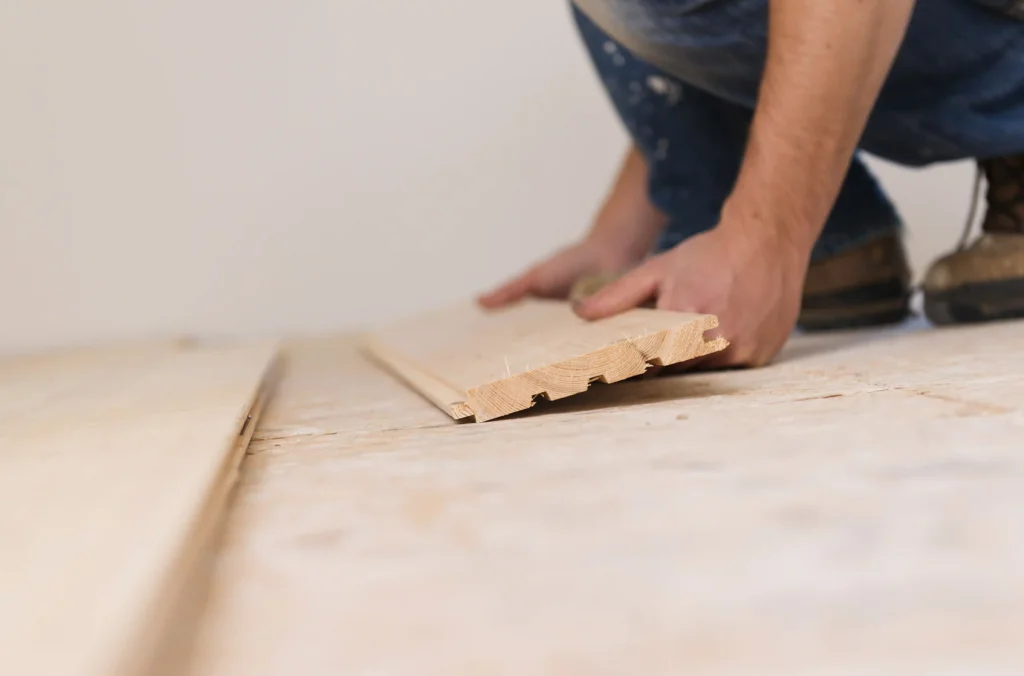
The single most underestimated factor in bamboo flooring durability is installation quality. Manufacturing defects account for fewer than 20 percent of bamboo floor failures in practice. The remaining failures trace to moisture management errors, inadequate acclimation, subfloor preparation failures, and incorrect expansion gap sizing.
Acclimation requires bamboo planks to equilibrate with the room’s temperature and humidity before installation. The National Wood Flooring Association recommends a minimum 72-hour acclimation period for bamboo, but strand-woven bamboo may require 5 to 7 days in regions with high humidity variation. Planks installed before reaching equilibrium continue to expand or contract after the floor is locked in place, generating internal stress that produces cracking, gapping, or buckling within the first seasonal cycle.
Expansion gaps of at least 1/4 inch must be maintained at all walls, door frames, and fixed vertical surfaces. Installers who reduce this gap to 1/8 inch to minimise visible trim space create a system that runs out of contraction room in low-humidity winter conditions. The floor pulls against the baseboard, generating noise, stress fractures, and in severe cases, plank separation at the joints. The correct bamboo flooring acclimation process sets the conditions for durable performance before a single plank is laid.
Subfloor flatness directly affects long-term plank stability. Bamboo planks spanning a subfloor depression of more than 3/16 inch per 10-foot run flex under load, fatiguing the adhesive or locking mechanism and eventually producing movement at the joints. Movement at the joints exposes the bamboo’s unfinished edges to foot traffic, accelerating edge wear and allowing moisture infiltration at the seam.
Glue-down installation, when executed correctly over a well-prepared subfloor, produces the most dimensionally stable bamboo floor. Floating installation allows individual planks to respond independently to humidity, reducing the risk of systemic buckling but increasing the transmission of movement noise. Nail-down installation suits solid bamboo over wood subfloors and provides good stability in temperate climates with moderate humidity variation.
How Long Bamboo Flooring Holds Up in Real-Use Conditions
High-quality strand-woven bamboo installed correctly in a temperature-controlled residential environment typically maintains its structural and aesthetic integrity for 25 to 50 years. This lifespan assumes indoor relative humidity maintained between 40 and 65 percent, routine cleaning that removes abrasive grit before it works against the finish, and the use of felt pads under furniture legs to prevent concentrated point loads.
Natural horizontal and vertical bamboo products in similar conditions produce lifespans of 15 to 25 years before surface wear, finish degradation, or dimensional movement requires either refinishing or replacement. The shorter lifespan reflects both lower initial hardness and greater sensitivity to humidity fluctuation.
Commercial installations in high-traffic environments — retail corridors, airport concourses, office lobbies — demonstrate bamboo’s load-bearing durability convincingly. A well-documented installation in a bookstore at San Francisco International Airport has sustained more than 20 million pedestrian passes without structural failure. These commercial results apply directly to residential high-traffic zones: entryways, kitchens, and living room corridors where foot traffic concentrates.
Lifespan shortens significantly in three conditions: high ambient humidity above 70 percent sustained for extended periods, failure to clean abrasive particles from the surface regularly, and installation over a subfloor with unresolved moisture transmission. Understanding how long bamboo flooring lasts under different conditions requires separating product tier, construction type, and installation environment — the answer varies by 20 years or more depending on these inputs.
What Actually Damages Bamboo Flooring Most Frequently
Sharp-edged grit — sand, stone fragments, and construction debris — carried on shoe soles produces the majority of surface scratching on bamboo floors in residential use. These particles act as abrasives between the shoe sole and the finish layer, generating fine scratches that accumulate into visible surface dulling. The damage occurs on the protective finish, not the bamboo substrate, and is preventable by placing mats at entry points and sweeping or vacuuming before grit migrates to high-traffic corridors.
Unprotected furniture legs concentrate loads over a contact area of approximately 1 to 4 square centimetres. A 90 kg dining chair with four steel legs bearing equal weight applies approximately 22.5 kg per leg. Dragging this chair across the floor multiplies the contact stress and drags any trapped grit particle across the finish surface. Felt pads with a minimum contact diameter of 25 mm distribute the load and eliminate grit-drag damage.
Pet claws — particularly from large dog breeds — generate repeated fine scratching across the surface during normal movement. The force applied by a dog’s claw during acceleration from rest reaches 5 to 15 Newtons per claw contact point, concentrated on an area of less than 1 square millimetre. Against a strand-woven bamboo substrate this force rarely produces deep indentation, but against a compromised or thin finish layer it generates visible surface tracks. Strand-woven bamboo’s performance with pets is substantially better than horizontal or vertical bamboo, but finish quality remains the determining variable.
Standing water from appliance leaks, plant saucers, and overflow events produces irreversible swelling in bamboo planks that absorb moisture through unfinished edges. A 24-hour water exposure event that soaks the edges of multiple planks typically produces permanent cupping or swelling that no amount of drying will fully reverse. This represents a harder durability limit than scratch resistance — surface scratches can often be sanded and refinished, but moisture-swollen planks must be replaced.
UV exposure from direct sunlight fades bamboo flooring’s surface colour and degrades the protective finish layer. Natural bamboo lightens toward a bleached straw tone over 2 to 5 years of direct sun exposure. Carbonized bamboo fades from its caramel tone toward a lighter brown. UV-blocking window film reduces this fading rate significantly. The finish degradation caused by UV exposure accelerates moisture absorption at the surface and reduces the floor’s effective abrasion resistance.
How to Assess Bamboo Durability Before Purchasing
Janka hardness should be the starting point, not the conclusion, of any durability assessment. Verify whether the published Janka figure applies to the specific product being purchased — not a different product from the same manufacturer — and whether the test was conducted on the finished plank or on the raw substrate before finishing.
Finish layer specification matters more than substrate hardness for most residential buyers. Request the finish coat count, the presence or absence of aluminum oxide in the wear coats, and the curing method (UV-cured vs. air-dried). A UV-cured, aluminum oxide-enhanced finish applied in 8 to 10 coats outperforms a 3-coat standard polyurethane finish regardless of the Janka differential between the two substrates.
Plank thickness determines refinish potential and structural rigidity. Bamboo planks rated at 14 mm or above provide enough material depth for at least one professional sanding. Planks below 10 mm total thickness carry insufficient material for safe refinishing and must be replaced when the finish fails. The relationship between plank thickness and long-term durability is direct — thicker products maintain their structural options over time.
Product grade reflects the selection criteria applied to raw bamboo before processing. High-grade bamboo uses culms harvested at full maturity — between 5 and 7 years — when the silica content and fibre density reach their maximum. Low-grade bamboo uses immature culms harvested at 2 to 3 years, producing planks with lower density and greater susceptibility to damage. Grade labelling varies across manufacturers and is not standardised internationally, which makes third-party certification a more reliable quality signal than grade designations alone.
Certifications from the Forest Stewardship Council (FSC), CARB Phase 2 compliance for formaldehyde emissions, and third-party hardness testing by accredited laboratories provide verifiable performance benchmarks. Products from manufacturers who publish independent test results carry demonstrably less risk of misrepresented durability claims than products relying solely on self-reported specifications.
The Conditions Under Which Bamboo Flooring Is Not Durable
Bamboo flooring performs poorly in rooms where indoor relative humidity regularly exceeds 70 percent without active dehumidification. Basements, bathrooms, and laundry rooms in humid climates subject bamboo planks to continuous moisture stress that eventually overcomes any surface sealing. The planks swell, the locking joints loosen, and the floor begins moving underfoot. These are not installation failures — they are product-environment mismatches that no installation quality can compensate for.
Radiant floor heating systems that cycle between 15°C and 28°C surface temperature daily create rapid, repeated dimensional change in bamboo planks. This thermal cycling fatigues the adhesive joints in laminated bamboo more aggressively than it does in solid hardwood, because bamboo’s cellular structure responds to temperature change more quickly than dense wood fibres. Strand-woven bamboo tolerates radiant heat better than horizontal or vertical bamboo but still requires manufacturer approval and strict humidity control to maintain warranty coverage.
High-gloss carbonized bamboo in a household with multiple large dogs represents the most common scenario where bamboo flooring fails to meet durability expectations. The combination of reduced substrate hardness from carbonization, fine claw scratching concentrated in movement corridors, and the visibility amplification of a high-gloss finish creates a floor that shows wear rapidly and cannot be restored without full refinishing. This specific combination appears frequently in durability complaints and drives most negative reviews of bamboo flooring as a category.
The conditions that make bamboo a poor durability choice are predictable and avoidable. Knowing where bamboo flooring should not be installed prevents the mismatches that produce most durability failures.
The Honest Durability Verdict on Bamboo Flooring
Strand-woven bamboo, finished with a multi-coat aluminum oxide surface and installed correctly over a moisture-controlled subfloor, is one of the most durable flooring materials available at its price point. Its Janka ratings exceed most domestic hardwood species, its finish options rival premium engineered wood products, and its lifespan in controlled residential environments matches or exceeds the 25-year performance threshold that defines a durable floor.
Natural horizontal and vertical bamboo occupy a different durability tier. They perform comparably to mid-range hardwood species, offer adequate durability in moderate-traffic spaces, and require more attentive humidity management than their strand-woven counterparts. They are not fragile products, but they should not be evaluated using strand-woven hardness figures.
The durability failures that generate negative reviews — surface scratching, moisture swelling, cupping, gapping — originate primarily from product-environment mismatches and installation errors, not from manufacturing defects. A correctly specified, correctly installed bamboo floor in an appropriate environment delivers on its durability claims. The same product in a high-humidity basement, installed without acclimation or proper expansion gaps, fails within two seasonal cycles regardless of its Janka rating.
The decision to select bamboo over other flooring materials depends on more than raw hardness. Buyers evaluating the full picture should examine bamboo flooring’s complete performance profile — covering cost, maintenance requirements, refinishability, and environmental credentials — before committing to a product type and grade.