Bamboo flooring divides into two structurally different products — solid and engineered — and the difference between them determines moisture tolerance, installation method, refinishing potential, and compatibility with subfloor types. Both share the same surface material, but the internal construction changes how each product responds to heat, humidity, and mechanical stress over decades of use. Choosing between them without understanding those structural differences leads to warping, delamination, or a floor that simply cannot be installed in the room you intend.
What Solid Bamboo Flooring Is and How It Is Constructed
Solid bamboo flooring is a plank manufactured entirely from compressed bamboo material, with no secondary core layer underneath the surface. Manufacturers harvest Moso bamboo culms at five to six years of maturity, split them into strips or shred them into fibers, then bond those elements under heat and pressure to form a uniform plank from top to bottom. The two dominant construction methods produce either horizontal bamboo, which laminates strips with the node face visible, or vertical bamboo, which orients strips on their edge to expose the grain in a tighter pattern. A third method — strand-woven production — shreds culms into fibers and compresses them under pressures exceeding 3,000 psi, creating the densest form of solid bamboo available.
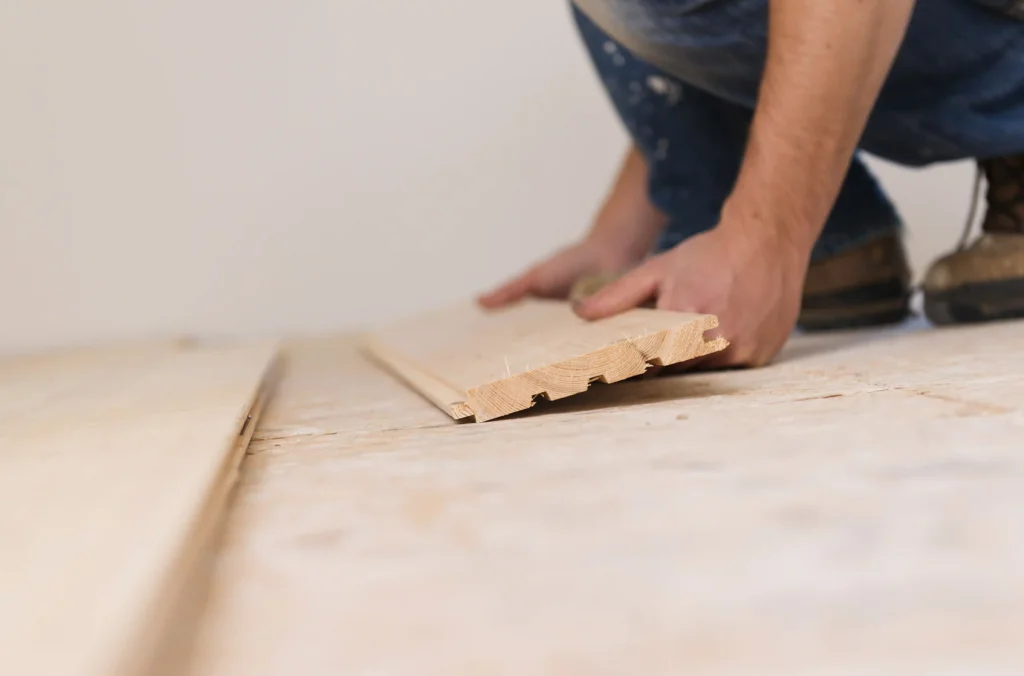
Solid planks typically measure 12 mm to 19 mm in overall thickness. Because the bamboo material runs through the full depth of the board, the entire thickness functions as the usable wear layer. This structure allows solid bamboo to be sanded and refinished two to three times across its service life. The tongue-and-groove profile milled into solid planks requires either nail-down or glue-down installation — the plank is too dense and dimensionally active to float reliably over long spans without mechanical fastening.
What Engineered Bamboo Flooring Is and How Its Layers Work
Engineered bamboo flooring consists of a genuine bamboo wear layer bonded to a multi-layer core of plywood or high-density fiberboard (HDF). The bamboo surface layer — typically 2 mm to 6 mm thick depending on the product grade — provides the visible appearance and the functional wear surface. The core beneath it runs in alternating grain directions, a cross-ply construction that resists dimensional movement in response to humidity and temperature changes. Manufacturers laminate three to nine individual plies together, depending on the target thickness and stability specification of the product.
The core material determines performance characteristics beyond stability. Plywood cores — often made from eucalyptus, poplar, or pine — distribute stress across multiple grain orientations and handle moisture cycling better than single-material cores. HDF cores offer a Janka hardness rating of approximately 1,700 lbf at the core level, which resists indentation from below the wear surface. Plywood, by comparison, uses species with Janka ratings between 500 and 1,200 lbf, but its cross-grain layering provides superior structural recovery after compression. Premium engineered bamboo products specify the core material and ply count; budget products frequently omit this detail. The total plank thickness for engineered bamboo ranges from 10 mm to 15 mm, with overall dimensions allowing wider plank formats up to 190 mm — a width that solid bamboo cannot achieve without structural compromise.
How Moisture and Humidity Affect Each Construction Type Differently
Solid bamboo expands and contracts along its width when indoor relative humidity rises or falls. Horizontal and vertical solid bamboo absorb moisture across the grain and can swell by 1% to 3% of their width for every significant humidity shift — enough to produce visible gaps in winter at 25% RH or cupping in summer at 70% RH. Maintaining interior humidity between 35% and 55% relative humidity reduces this movement to an acceptable range for most installations. Bamboo’s expansion and contraction behavior is more pronounced in horizontal and vertical constructions than in strand-woven formats because fiber alignment in those products is unidirectional.
Engineered bamboo’s cross-ply core restricts this dimensional movement. Each alternating ply works against the one beneath it, preventing the floor from expanding uniformly in any single direction. The result is a product with measurably lower seasonal movement — typically 30% to 50% less width variation than an equivalent solid plank under the same humidity conditions. This property makes engineered bamboo the correct choice for finished basements, kitchens, and rooms built over crawl spaces where ground moisture creates persistent vapor pressure against the subfloor. Neither construction type tolerates standing water or chronic subfloor leaks — but engineered bamboo handles intermittent humidity swings without visible damage that solid bamboo would show within one season.
Refinishing Potential: How Many Times Each Type Can Be Sanded
Solid bamboo can be sanded and refinished two to three times over its service life, provided the plank is 14 mm or thicker. The full-depth construction means each sanding removes only the surface material, leaving substantial bamboo below. Strand-woven solid bamboo presents a refinishing challenge because its extreme density — reaching up to 3,000 lbf on the Janka scale — dulls standard drum sander belts faster than conventional hardwood. A professional with experience sanding bamboo should perform this work to avoid uneven material removal or heat discoloration from excessive friction.
Engineered bamboo’s refinishing potential depends entirely on the wear layer thickness. A 2 mm wear layer allows one light screen-and-recoat. A 4 mm to 6 mm wear layer supports one full sand-and-refinish and one additional screen-and-recoat before the core becomes exposed. Budget engineered products with wear layers below 2 mm cannot be refinished at all — the risk of sanding through to the core is too high. When evaluating engineered bamboo products, the wear layer specification is more important than the overall plank thickness for understanding long-term maintenance options. Whether refinishing bamboo flooring is feasible depends on these measurements, not on brand claims about durability.
Installation Methods Each Construction Type Supports
Solid bamboo installs using nail-down or glue-down methods. Nail-down installation drives cleats through the tongue of each plank into a wood subfloor, creating a mechanically fastened assembly. This method requires a plywood or OSB subfloor at least 19 mm thick — concrete does not accept nails, and nail-down over concrete is not viable without a plywood sleeper system. Glue-down installation bonds solid planks directly to a prepared concrete or wood subfloor using a full-spread trowel adhesive, but the subfloor must be flat to within 3 mm over 1.8 m and completely dry before application.
Engineered bamboo supports all three installation methods — nail-down, glue-down, and floating. The floating method uses a click-lock profile or a tongue-and-groove system with adhesive at the joint, allowing the floor to move as a single assembly above the subfloor without mechanical attachment. Floating installation works over concrete, existing tile, and even some resilient flooring, making engineered bamboo the practical choice when removing existing floor covering is not feasible. The trade-offs between floating and glue-down bamboo installation affect long-term stability, sound transmission, and warranty coverage — and that decision matters differently depending on whether the product is solid or engineered.
Radiant Heat Compatibility Between Solid and Engineered Bamboo
Engineered bamboo works with radiant floor heating systems because the cross-ply core moderates the thermal expansion the heat source generates beneath the floor. The layered construction absorbs the slow, cyclical heating and cooling of a hydronic or electric radiant system without developing gaps or buckling. The floor temperature beneath an engineered bamboo installation should not exceed the manufacturer’s specified maximum — typically 27°C (80°F) — and temperature changes should stay below 2°C per hour to prevent stress at the adhesive bonds between plies.
Solid bamboo is not recommended over radiant heat by most manufacturers. The dimensional movement of a solid plank under a continuous heat source — which cycles between on and off states and dries the subfloor atmosphere — generates stress that produces gapping, cupping, or splitting over one to two heating seasons. Some strand-woven solid bamboo products carry manufacturer approval for radiant heat installations when glued down, but this approval requires confirming maximum temperature limits in the product warranty before installation. When in-floor heating is part of the project specification, engineered bamboo removes the installation risk that solid bamboo introduces.
How Solid and Engineered Bamboo Differ in Hardness and Surface Durability
The surface hardness of both construction types depends on the bamboo manufacturing method used for the wear layer, not on whether the product is solid or engineered. Horizontal and vertical bamboo — whether solid or as a veneer on an engineered board — typically score between 1,000 and 1,400 lbf on the Janka hardness scale, comparable to white oak at 1,360 lbf. Strand-woven bamboo, available in both solid planks and as the wear layer on engineered products, achieves Janka ratings between 2,200 and 3,000 lbf — harder than most domestic hardwood species including hickory at 1,820 lbf.
The core material in engineered bamboo contributes indirectly to surface dent resistance. A high-density core reduces the flex beneath the wear layer when a point load — a chair leg, a stiletto heel, a dropped object — strikes the surface. A floor with flex in the substrate compresses more under impact than one with a rigid foundation, which means a thin wear layer over a soft core produces more visible indentation than the Janka rating of the surface alone would suggest. For engineered bamboo used in high-traffic areas, a plywood core outperforms an HDF core in impact recovery because plywood’s cross-ply structure springs back after compression rather than permanently deforming.
Acclimation Requirements Before Installation
Solid bamboo requires acclimation of three to seven days in the installation environment before fitting. The planks must sit horizontally, stacked with spacers to allow airflow, at the humidity and temperature conditions the room will maintain during service. Skipping acclimation or shortening the period causes the solid planks to continue adjusting after installation, producing gaps or buckling within the first season. The bamboo flooring acclimation process is especially critical for solid constructions because the full-depth bamboo material responds more aggressively to humidity differentials than a thin veneer bonded to a stable core.
Engineered bamboo requires a shorter acclimation period — typically 24 to 48 hours — because the cross-ply core limits the dimensional change the product undergoes during adjustment. The wear layer still acclimates to the room conditions, but the core prevents the rapid, large-scale movement that solid planks can exhibit during the same period. In practice, some manufacturers of premium engineered bamboo specify no mandatory acclimation period when the product is stored in a climate-controlled warehouse, but on-site acclimation remains best practice to eliminate installation risk in humid climates.
Cost Differences Between Solid and Engineered Bamboo Flooring
Engineered bamboo costs more per square foot than equivalent solid bamboo in the same construction style (horizontal, vertical, or strand-woven). The additional manufacturing stages — bonding the wear layer, pressing the core plies, machining the click-lock or tongue-and-groove profile — increase production cost by 15% to 30% compared to a solid plank at the same wear-layer quality. Material prices for solid horizontal or vertical bamboo range from $2 to $5 per square foot; engineered bamboo in the same aesthetic category ranges from $4 to $9 per square foot. Strand-woven solid bamboo at premium density falls between $5 and $10, while engineered strand-woven bamboo reaches $7 to $12 per square foot for products with 4 mm or thicker wear layers.
Installation labor costs shift the total comparison. Solid bamboo’s nail-down or glue-down requirement adds labor time and, for glue-down, the cost of full-spread trowel adhesive. Engineered bamboo with a floating click system reduces installation time by 20% to 35% compared to nail-down solid bamboo, partially offsetting the higher material cost. Total bamboo flooring installation cost across both types depends on subfloor preparation needs, room complexity, and whether an underlayment is required — factors that often matter more than the per-square-foot material difference.
Which Rooms Suit Solid Bamboo and Which Suit Engineered Bamboo
Solid bamboo performs best in above-grade, climate-controlled rooms where humidity stays consistently between 35% and 55% relative humidity year-round. Living rooms, bedrooms, hallways, and home offices in homes with functioning HVAC systems present stable conditions that solid bamboo handles without dimensional stress. Solid strand-woven bamboo suits high-traffic corridors and commercial-grade residential environments because its surface density resists scratch and dent damage without a secondary core to compromise.
Engineered bamboo extends bamboo flooring into environments where solid bamboo creates installation risk. Kitchens experience humidity spikes during cooking and cleaning. Basements sit at or below grade, where ground moisture elevates subfloor vapor pressure throughout spring and summer. Rooms over radiant heat systems cycle through temperature and humidity changes daily. Engineered bamboo handles all three scenarios because the cross-ply core absorbs the dimensional stress that would cause a solid plank to move visibly. The rooms where bamboo flooring performs reliably depend on the construction type chosen as much as the species or finish applied.
VOC Emissions and Adhesive Considerations in Each Construction Type
Engineered bamboo uses adhesives at two stages — during core lamination and during wear-layer bonding. Each adhesive stage represents a potential source of volatile organic compound (VOC) emissions if the product uses urea-formaldehyde resins. Products certified to CARB Phase 2 or Greenguard Gold standards meet formaldehyde emission limits below 0.05 ppm for composite wood products, which is the standard required by California’s Air Resources Board. Solid bamboo uses adhesive only to bond the bamboo strips or fibers within the plank itself — the compression bonding process requires less adhesive volume than the multi-layer engineered construction, which typically results in lower total off-gassing.
The practical difference in indoor air quality between certified engineered and certified solid bamboo is negligible within 30 days of installation, when VOC emission rates for both products fall to background levels. The risk occurs in uncertified products — particularly those manufactured without third-party emission testing — where formaldehyde levels can exceed 0.1 ppm during the first six months. Bamboo flooring safety and VOC emissions require scrutiny of the product certification, not assumptions based on whether the construction is solid or engineered.
Lifespan and Long-Term Performance Comparison
The surface lifespan of solid and engineered bamboo is identical when the wear layer material is the same. A horizontal solid bamboo floor and a horizontal engineered bamboo floor with a 4 mm wear layer will show the same scratch pattern, the same color shift from UV exposure, and the same finish wear rate over 10 to 15 years of residential use. The structural lifespan diverges at the point when the subfloor environment changes. Solid bamboo installed in a room that later develops a moisture problem — a plumbing leak, rising ground moisture, or chronic humidity neglect — will warp, cup, or develop permanent gaps faster than an engineered floor in the same conditions.
Engineered bamboo’s vulnerability lies in the adhesive bond between the wear layer and the core. Delamination — the separation of the bamboo veneer from the substrate — occurs when water penetrates the joint edge and dissolves the adhesive over time. Products with plywood cores and waterproof adhesive systems resist delamination longer than those with HDF cores and standard PVA glue. Quality solid bamboo, by contrast, contains no adhesive joints below the surface — any damage from moisture is structural expansion rather than layer failure. How long bamboo flooring lasts in practice depends more on maintenance conditions and installation quality than on whether the product is solid or engineered.
The Decision Framework: Which Construction Type Matches Your Conditions
Solid bamboo is the correct choice when the subfloor is wood, the room sits at grade or above, HVAC maintains stable year-round humidity, and refinishing at 15 to 20 year intervals is part of the long-term maintenance plan. Strand-woven solid bamboo adds surface hardness to that scenario, making it appropriate for pet owners and households with high foot traffic. The nail-down installation method provides a firm, non-hollow feel underfoot that floating engineered floors do not replicate.
Engineered bamboo is the correct choice when the subfloor is concrete, the installation sits below grade, radiant heat is present, or the room experiences regular humidity variation above 55% relative humidity. The floating installation method reduces labor cost and allows removal without subfloor damage — relevant for renters or renovation projects where reversibility matters. A wear layer of 4 mm or more preserves refinishing as a future option, extending the engineered product’s service life beyond the single-replacement cycle that budget engineered floors offer.
The surface aesthetics of both types are identical once installed — neither horizontal grain, vertical grain, nor strand-woven texture distinguishes itself as uniquely “solid” or “engineered” to a visual inspection. The decision is entirely structural. Rooms with controlled conditions reward solid bamboo’s refinishing depth. Rooms with moisture variability and concrete subfloors demand engineered bamboo’s dimensional stability. Getting this choice wrong produces problems that no finish, cleaning regimen, or maintenance schedule can correct — which is why understanding the construction difference before purchase matters more than any surface specification the manufacturer lists.
For buyers comparing bamboo against other floor categories, the structural logic that separates bamboo from engineered hardwood follows similar principles — the core material and wear layer thickness drive performance, while the surface species determines aesthetics and hardness.