Bamboo flooring emits volatile organic compounds primarily through the adhesive resins used to bind its compressed fibers — not through the bamboo plant itself. Whether those emissions reach harmful concentrations inside a home depends on three variables: the resin type selected during manufacturing, the product’s certification status, and the ventilation conditions after installation. Formaldehyde is the compound most closely scrutinized, and its presence in bamboo flooring is directly tied to how the planks are manufactured, not to bamboo as a raw material.
What VOCs Are and Why Flooring Emits Them
Volatile organic compounds (VOCs) are carbon-based chemicals that convert to gas at room temperature, a process called off-gassing. Flooring products release VOCs from three sources: the adhesive resins used in manufacturing, the surface finish applied to the plank, and — in glue-down installations — the installation adhesive applied to the subfloor.
Formaldehyde is classified as a VOC and is the primary compound tested in bamboo flooring certification. The World Health Organization lists formaldehyde as a Group 1 carcinogen, meaning evidence links it to cancer in humans at sustained high-concentration exposure. The U.S. Centers for Disease Control confirms that even low-level formaldehyde exposure causes eye, nose, and throat irritation in otherwise healthy individuals.
Other VOCs found in lower-quality bamboo finishes include benzene, toluene, and acetaldehyde, which originate from solvent-based surface coatings rather than from the adhesive core of the plank.
Where Formaldehyde Enters the Bamboo Manufacturing Process
Raw Moso bamboo culms contain no formaldehyde. The compound enters the product when bamboo strips or fibers are bonded with adhesive resins during compression. Two resin types dominate the industry: urea-formaldehyde (UF) and phenol-formaldehyde (PF).
Urea-formaldehyde resin is cheaper to produce, cures faster, and historically produced higher off-gassing rates over time. Phenol-formaldehyde resin costs more but emits formaldehyde at significantly lower rates because the chemical bond between phenol and formaldehyde is more stable at room temperature. Premium manufacturers have largely transitioned to PF resins or to no-added formaldehyde (NAF) alternatives such as MDI (methylene diphenyl diisocyanate) adhesives and soy-based binders.
The surface finish adds a second emission pathway. Solvent-based polyurethane finishes release high concentrations of VOCs during and immediately after application. UV-cured, water-based polyurethane finishes — standard on higher-quality products — emit measurably lower VOC levels and are considered safe for indoor residential use.
How Strand-Woven Bamboo Differs from Horizontal and Vertical Bamboo in VOC Risk
Strand-woven bamboo uses more adhesive per unit volume than horizontal or vertical bamboo flooring because the manufacturing process shreds bamboo into loose fibers before compression. Those fibers require a higher resin-to-fiber ratio to achieve the density and structural integrity that gives strand-woven bamboo its exceptional hardness.
The consequence is straightforward: a strand-woven plank manufactured with UF resin contains more formaldehyde-emitting adhesive than a horizontal or vertical plank of the same dimensions. This makes the resin type a more consequential variable in strand-woven products. High-quality strand-woven flooring produced with PF resin or MDI binders achieves emission levels well within safety limits. Budget strand-woven flooring using UF resin represents the highest VOC risk in the bamboo flooring category.
Horizontal and vertical bamboo planks bond larger bamboo strips rather than compressed fibers, using less adhesive overall. Solid horizontal or vertical bamboo manufactured without a composite core produces the lowest formaldehyde emissions among all bamboo flooring types — a pattern consistent with Consumer Reports findings that solid construction correlates with lower formaldehyde output than engineered or composite constructions.
The Certification Standards That Govern Formaldehyde Limits
Four certification frameworks set the enforceable or voluntary emission limits most relevant to bamboo flooring sold in North America and Europe.
CARB Phase 2 / EPA TSCA Title VI: The California Air Resources Board’s Airborne Toxic Control Measure (ATCM) Phase 2 limits formaldehyde emissions from composite wood platform materials to 0.05 ppm for hardwood plywood. The U.S. Environmental Protection Agency adopted identical numerical limits under TSCA Title VI, making these standards nationally enforceable since June 2018. Engineered bamboo flooring containing composite wood components must meet Phase 2 standards and carry compliant labeling.
E1 / E0 (European Standards): The European E1 standard permits up to 0.124 mg/m³ of formaldehyde emissions. The stricter E0 standard limits emissions to 0.05 mg/m³. Products meeting E0 are considered suitable for sensitive environments including schools and hospitals.
GREENGUARD Gold: UL’s GREENGUARD Gold certification tests for more than 10,000 chemicals including formaldehyde, with a limit of 0.0073 ppm — approximately 15 times stricter than CARB Phase 2’s 0.11 ppm limit for MDF. GREENGUARD Gold considers the health thresholds of sensitive populations including children and the elderly, making it the most protective voluntary certification available for flooring products.
FloorScore: The Resilient Floor Covering Institute’s FloorScore certification measures total VOC and formaldehyde emissions from finished flooring products, including coatings. A FloorScore-certified bamboo floor has passed emissions testing at the finished-product level, accounting for the surface finish as an emission source — a variable that CARB Phase 2 does not directly address.
NAUF (No Added Urea Formaldehyde): NAUF is a manufacturing standard, not a third-party certification. It indicates that urea-formaldehyde resin was not added during production. Most high-quality bamboo flooring sold in the U.S. meets the NAUF standard. Manufacturers using PF resin may label products NAUF even though trace formaldehyde from PF resin can still technically be present at levels well below any measurable health threshold.
What Emission Levels Mean in Practice
Budget bamboo flooring manufactured with UF resin can produce formaldehyde emissions between 0.2 and 0.3 ppm at the time of manufacture. Premium bamboo flooring certified to CARB Phase 2 emits below 0.05 ppm. Products from manufacturers using MDI or soy-based binders achieve levels at or below 0.02 ppm — lower than the formaldehyde concentration present in most ripe fruit. A banana contains approximately 58.3 ppm of formaldehyde; a cup of coffee contains more formaldehyde per million parts than a compliant bamboo plank emits into a room.
These comparisons exist not to minimize the risk but to calibrate it. The meaningful health concern with indoor formaldehyde is sustained exposure at elevated concentrations, particularly in poorly ventilated spaces or in homes with multiple formaldehyde-emitting sources. A certified bamboo floor installed in a well-ventilated room does not, on its own, produce formaldehyde concentrations associated with adverse health effects in healthy adults.
Individuals with asthma, compromised respiratory function, or known chemical sensitivities operate at lower exposure thresholds. For those households, GREENGUARD Gold certification provides a more appropriate safety baseline than CARB Phase 2 alone.
How the Installation Method Affects Total VOC Exposure
The flooring plank is one emission source. The installation method introduces a second. Glue-down installation requires a subfloor adhesive, which contributes its own VOC load during application and curing. Many installation adhesives are solvent-based and produce concentrated off-gassing for 24 to 72 hours after application.
Water-based or low-VOC adhesives certified to meet FloorScore or GREENGUARD standards add minimal off-gassing to the total indoor air load. Using a low-emission plank with a high-VOC installation adhesive undermines the indoor air quality benefit of the certified flooring entirely. The choice between floating and glue-down installation carries a real air quality dimension, not just a structural one.
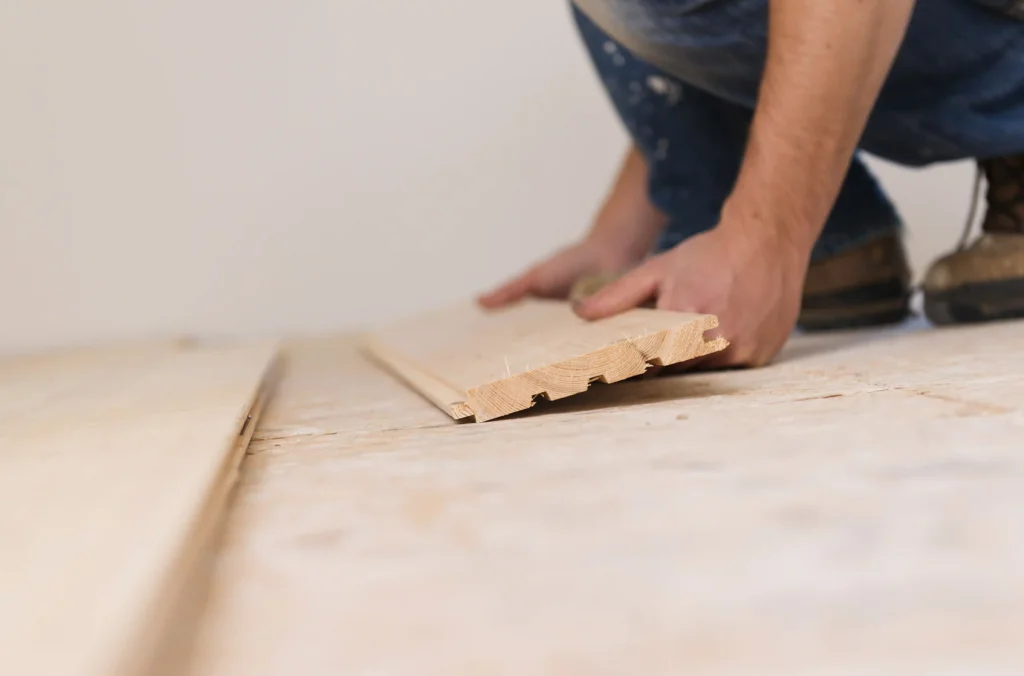
Floating installations using a click-lock or glueless tongue-and-groove system eliminate the installation adhesive variable entirely. The underlayment used beneath a floating floor still contributes minor VOCs, but certified foam or cork underlayments add negligible emissions compared to solvent-based subfloor adhesives.
Off-Gassing Duration and How to Accelerate Dissipation
New bamboo flooring emits the highest concentration of VOCs in the first days to weeks after installation. Emission rates decline over time as residual unreacted compounds exhaust themselves. A certified product installed under normal conditions reaches stable, low-emission equilibrium within two to four weeks, though products using lower-quality adhesives may off-gas at elevated rates for longer.
Ventilation is the most effective tool for reducing exposure during this period. Cross-ventilation — opening windows on opposing walls to create airflow — removes VOC-laden air faster than single-point ventilation. Maintaining room temperature between 18°C and 22°C slows the rate of off-gassing; higher temperatures accelerate emission release, which can be used deliberately to purge VOCs faster in uninhabited spaces before occupancy.
Activated carbon air purifiers capture VOCs at the molecular level and reduce indoor concentration effectively during the post-installation period. HEPA filters do not capture gases and provide no VOC reduction benefit.
Households with infants, young children, or immunocompromised individuals should ventilate aggressively for a minimum of seven days after installation and delay reoccupancy of the installed room where feasible.
How to Verify a Product’s Actual Emission Status Before Purchasing
Certification claims on packaging and manufacturer websites require verification, not acceptance. Resin batches vary, panel suppliers change, and a CARB Phase 2 sticker represents a test result from a prior production run, not a guarantee of current output. Four steps provide meaningful confirmation.
First, request the actual third-party test report, not just a claim of compliance. Legitimate test reports identify the testing laboratory, the test date, and the measured emission value in ppm. A report dated more than 18 months ago offers less assurance than a recent one. Second, check whether the brand appears in the CARB certification database maintained by the California Air Resources Board, which lists verified third-party certifiers and their approved products. Third, review the Material Safety Data Sheet (MSDS) for the product, which discloses the adhesives and coatings used in manufacturing. Fourth, for maximum assurance, select products carrying GREENGUARD Gold certification rather than relying on CARB Phase 2 compliance alone, given the 15-fold difference in formaldehyde allowance between the two standards.
Price correlates meaningfully with emission quality at the category extremes. Bamboo flooring priced below $2.00 per square foot from unverified suppliers represents the highest risk for non-compliant formaldehyde emissions. The gap between budget and premium bamboo flooring is most consequential when indoor air quality is a primary concern.
VOC Risk in the Context of Other Flooring Materials
Laminate flooring consistently produces the highest formaldehyde emissions among common residential flooring categories, primarily because MDF core panels bond wood particles with UF resin at high density. Vinyl plank flooring emits formaldehyde at lower levels than laminate but contributes phthalates and other plasticizer-related VOCs absent from bamboo. Solid hardwood flooring produces the lowest formaldehyde emissions of any wood-based flooring category because no adhesive core exists in the plank construction.
Certified bamboo flooring occupies a position comparable to certified engineered hardwood in total VOC output. Both use composite cores and both require third-party certification to confirm safe emission levels. Uncertified bamboo flooring and uncertified engineered hardwood carry equivalent risk profiles, with emission levels determined by the manufacturer’s resin choices rather than by the raw material category.
The floor finish creates an additional differentiation point. The finish type applied to bamboo flooring determines not only durability and sheen but also the VOC contribution from the surface coating — a variable that accounts for a measurable share of total indoor off-gassing from any finished flooring product.
Who Bears the Highest Risk from Bamboo Flooring VOCs
Children metabolize formaldehyde differently than adults and spend more time in contact with floor surfaces, increasing their relative exposure. The GREENGUARD Gold standard was developed specifically with children’s environments in mind, including schools and daycares. For homes with children under five, GREENGUARD Gold certification is the appropriate minimum standard, not an optional upgrade.
Individuals with asthma experience bronchospasm at formaldehyde concentrations that healthy adults tolerate without symptoms. The CDC threshold for irritation in sensitive individuals sits at concentrations lower than those permitted under CARB Phase 2. Asthmatic households should prioritize products achieving GREENGUARD Gold certification or tested below 0.02 ppm.
The elderly and those with compromised hepatic or renal function eliminate formaldehyde from the body at slower rates, extending the window of effective exposure per inhalation event. The same GREENGUARD Gold threshold applies as the relevant target for these households.
Pregnant women represent a separate consideration. Formaldehyde crosses the placental barrier at sustained high exposures. No evidence establishes harm at the emission levels produced by certified bamboo flooring, but the precautionary principle supports selecting GREENGUARD Gold-certified products and ventilating thoroughly for the first two weeks after installation.
The Sustainability Claim and Its VOC Contradiction
Bamboo flooring is frequently marketed as an eco-friendly and health-safe alternative to hardwood. The ecological case for bamboo rests on its rapid regrowth cycle — Moso bamboo reaches harvest maturity in three to five years compared to 20 to 120 years for hardwood timber species. The indoor air quality case, however, depends entirely on how the bamboo is processed, not on its botanical origin.
A bamboo floor bonded with high-formaldehyde UF resin and coated with solvent-based polyurethane is not safer than laminate flooring from a VOC perspective, regardless of bamboo’s renewable-resource credentials. The sustainability claims that bamboo manufacturers make require the same scrutiny applied to emission certifications — renewable sourcing and safe indoor air quality are separate attributes that must each be verified independently.
What a Safe Bamboo Floor Purchase Looks Like
A bamboo floor that presents acceptable VOC risk carries all of the following: CARB Phase 2 compliance verified by a current third-party test report, a water-based or UV-cured surface finish, and PF, MDI, or NAF adhesive resin documented in the MSDS. GREENGUARD Gold certification satisfies all three requirements under a single audited standard. Households with children, asthmatic members, or chemically sensitive individuals should treat GREENGUARD Gold as non-negotiable rather than aspirational.
Installation method matters as much as product selection. A GREENGUARD Gold-certified plank installed with a solvent-based subfloor adhesive produces a total indoor VOC load that the plank certification alone does not account for. The adhesive, underlayment, and finish — evaluated as a system — determine the actual air quality outcome. Understanding how bamboo flooring is manufactured from raw culm to finished plank clarifies why the resin type governs emission risk at every stage of that process, and the full production sequence explains the specific points where formaldehyde enters and can be controlled.