Bamboo flooring performs differently depending on the moisture load, foot traffic pattern, and temperature stability of each room in a home. The manufacturing method — horizontal, vertical, or strand-woven — determines which rooms a given product can handle without warping, cupping, or premature wear. Matching the right bamboo type to the right room is the single most important decision in a bamboo flooring project.
Strand-woven bamboo, produced by compressing shredded bamboo fibres under heat and high pressure, achieves a Janka hardness rating between 3,000 and 4,000 lbf — more than double the 1,380 lbf of horizontal natural bamboo. That difference in density directly affects which rooms each type survives long-term. Rooms with stable humidity between 40% and 60% relative humidity and temperatures between 60°F and 80°F produce the best outcomes across all bamboo types.
Why Room Selection Determines Long-Term Bamboo Flooring Performance
Bamboo is a hygroscopic material, meaning it absorbs moisture from the surrounding air and releases it as conditions change. Every room in a home creates a distinct microclimate defined by water vapour output, temperature variation, and the frequency of foot traffic. A floor that thrives in a bedroom at 50% relative humidity can cup and buckle in a kitchen where steam, spills, and humidity spikes occur daily.
The moisture content of installed bamboo planks should fall between 6% and 9% at the time of installation. When ambient humidity pushes the moisture content above 10%, the planks expand, causing cupping along the edges. When indoor humidity drops below 35% — common in winter with forced-air heating — the planks contract, opening gaps between them. Both failure modes are room-specific problems, not product failures. Understanding how bamboo responds to seasonal humidity shifts before choosing a room prevents both outcomes.
Foot traffic intensity adds a second variable. A hallway or kitchen in an active household generates daily abrasion loads that a bedroom never sees. The Janka hardness rating determines resistance to surface denting from furniture legs, pet claws, and heavy foot traffic — but even a 3,000 lbf strand-woven floor will scratch if fine grit is tracked in and not swept before it acts as sandpaper underfoot.
Living Rooms: The Strongest Performing Environment for Bamboo
Living rooms represent the ideal installation environment for bamboo flooring across all manufacturing types. Temperature remains relatively stable, humidity stays within normal habitable ranges, and the primary stress is foot traffic rather than moisture exposure. Horizontal and vertical bamboo — both rating around 1,380 to 1,825 lbf on the Janka scale — perform reliably in living rooms with moderate to heavy use.
Strand-woven bamboo at 3,000 to 4,000 lbf handles living rooms with children, dogs, and frequent gatherings without showing denting under furniture or wear paths near doorways. Its compressed fibre structure also resists surface scratching better than natural horizontal bamboo, which can show fine scratches from chair legs within two to three years of installation in active households.
Sunlight exposure in living rooms introduces a specific risk: UV-driven colour change. Carbonized bamboo, which achieves its dark brown tone through a steam-heat process that reduces the Janka rating to approximately 1,000 to 1,100 lbf, fades unevenly when half the floor sits under direct sun while the other half is shaded by furniture. Natural bamboo lightens more uniformly. Using UV-filtering window coverings or applying an aluminium oxide finish product slows the discolouration rate regardless of bamboo type.
Open-plan layouts that connect a living room to a dining space or kitchen benefit from running the same bamboo flooring continuously, but that design choice requires the product to meet the higher moisture demands of the kitchen zone. Strand-woven bamboo engineered with a moisture-resistant core is the appropriate choice for continuous open-plan installations.
Bedrooms: Low Stress, Long Lifespan, Right Fit for All Bamboo Types
Bedrooms generate the lowest mechanical and moisture stress of any room in a home. Foot traffic concentrates near the bed, wardrobe, and door — the rest of the floor sees minimal contact. Humidity remains stable because bedrooms lack the steam-producing appliances found in kitchens and bathrooms. This makes bedrooms the safest room for horizontal and vertical bamboo, which perform comparably to red oak at 1,380 lbf but require more stable conditions than strand-woven products.
Children’s bedrooms introduce higher impact loads from dropped toys and furniture rearrangement. In those spaces, strand-woven bamboo provides a measurable hardness advantage. The compressed fibre structure resists the concentrated point loads created when heavy furniture is dragged across the surface. Felt pads under furniture legs are still necessary regardless of bamboo type — a hard steel chair leg dragged under load can scratch any finish regardless of the Janka rating of the substrate beneath it.
Master bedrooms benefit specifically from bamboo’s thermal comfort advantage over tile and stone. Bamboo conducts less heat than ceramic tile, producing a warmer underfoot feel in the morning. For bedrooms fitted with underfloor heating systems, engineered bamboo — which uses a cross-grain core construction to reduce expansion sensitivity — performs more predictably than solid bamboo, which can gap or cup when heated unevenly from below.
Dining Rooms: Managing Chair Leg Abrasion and Spill Risk
Dining rooms combine two stresses that individually manageable but challenging together: chair leg abrasion from repeated pulling in and out, and localised spill risk from food and liquid drops. Chair legs dragged across a floor surface without protective pads generate concentrated abrasion forces that surface-scratch any flooring, regardless of hardness rating. Felt glides on all chair legs eliminate approximately 80% of dining room floor scratch risk.
Spills in dining rooms are frequent but typically small in volume and short in duration — a wine splash wiped up within 30 seconds does not penetrate the finish layer of a properly sealed bamboo floor. The risk arises when liquid is left standing, particularly along plank seams where it can wick into the tongue-and-groove joint and reach the raw bamboo fibre beneath the finish coat. A quality aluminium oxide finish applied at the factory provides significantly more resistance to spill penetration than site-applied oil finishes, which require annual reapplication to maintain their moisture barrier.
Strand-woven bamboo is the recommended type for dining rooms with heavy chair traffic. Its higher density resists the concentrated point pressure of chair legs more effectively than horizontal bamboo, which can develop visible compression dents in the grain pattern after years of dining chair use. Area rugs under the dining table protect the floor zone that absorbs the highest concentration of chair leg contact.
Kitchens: Viable With the Right Product and Installation Method
Kitchens produce more moisture than any other room outside of bathrooms and laundry areas. Steam from cooking, water splashes at the sink, dishwasher condensation, and the daily foot traffic of an active cooking space create a demanding environment that exposes the weaknesses of lower-grade bamboo products. The key variable is not the kitchen itself — it is whether the specific bamboo product installed can handle repeated short-duration moisture events without swelling at the plank edges.
Strand-woven engineered bamboo — produced with a plywood or high-density fibreboard core bonded to a strand-woven wear layer — resists moisture-driven expansion more effectively than solid bamboo in kitchen conditions. The cross-ply construction of the engineered core counteracts the dimensional movement that single-direction solid planks exhibit when exposed to humidity fluctuations between 40% and 70% relative humidity, a range that kitchens regularly hit during cooking.
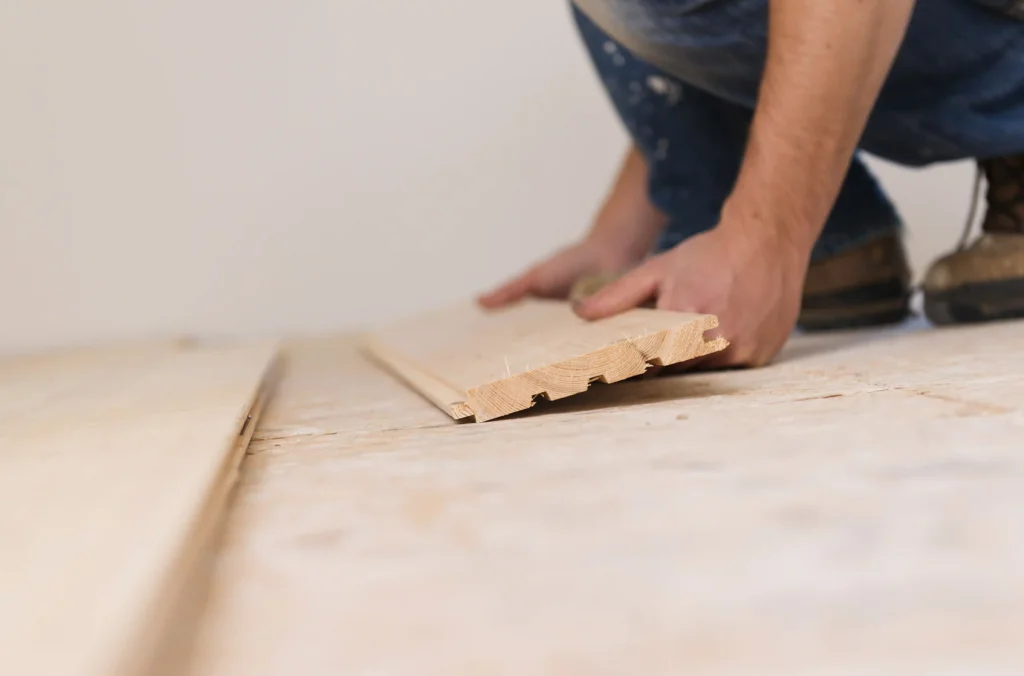
The sink zone and dishwasher surround represent the highest moisture exposure areas in any kitchen. A glue-down installation method — where planks are adhered directly to the subfloor using a moisture-resistant adhesive — prevents water from reaching the tongue-and-groove seams, which is the primary failure point in floating kitchen bamboo installations. Floating bamboo floors in kitchens rely solely on the finish coat to repel moisture at seams, and finish coats eventually wear through in high-traffic zones.
Solid horizontal or vertical bamboo is a poor fit for kitchens. Its open grain structure and relatively lower density make it vulnerable to edge-swelling at spill points and humidity cycles. The rooms where bamboo flooring consistently underperforms include kitchens where solid bamboo is installed via floating method without adequate expansion allowances at fixtures like kitchen islands.
Home Offices: Stability Under Low Traffic, Risk From Chair Casters
Home offices maintain stable temperature and humidity because they are consistently climate-controlled and generate no moisture from cooking or bathing. Foot traffic is minimal. Those two factors make bamboo flooring an appropriate choice for home offices across all manufacturing types. The problem specific to home offices is concentrated: rolling chair casters.
Standard hard casters on office chairs function as continuous abrasion tools on any hard floor surface. A single five-wheeled office chair used eight hours daily creates wear paths on natural horizontal bamboo within 12 to 18 months of installation. Polyurethane-coated soft casters, designed for hard floor use, eliminate this problem. Alternatively, a chair mat placed under the desk protects the floor in the highest-traffic zone while leaving the surrounding area exposed for aesthetic effect.
Strand-woven bamboo handles office chair casters better than horizontal or vertical bamboo due to its compressed fibre density, but soft casters remain the correct solution regardless of bamboo type. The floor’s Janka rating measures resistance to indentation, not to the continuous abrasion created by rolling contact under load.
Hallways and Entryways: Highest Traffic, Requires Maximum Hardness
Hallways and entryways receive the most concentrated foot traffic of any room in a home. Every person entering or leaving the house crosses the entry zone, which means it accumulates more abrasion cycles per square foot per day than any other surface. Grit and fine debris tracked in from outside acts as a micro-abrasive that scratches floor finishes on contact.
Strand-woven bamboo at 3,000 lbf or above is the minimum appropriate specification for hallways and entryways. Horizontal natural bamboo at 1,380 lbf develops visible wear paths within three to five years in active households. The higher compressed density of strand-woven products resists both the concentrated impact of heavy foot traffic and the surface micro-abrasion caused by outdoor grit. A low-pile entry mat that captures debris before it reaches the bamboo surface extends the finish life by two to three years regardless of the bamboo type installed.
Entryways adjacent to exterior doors also experience temperature differentials during winter months when cold outside air meets warm interior air at the door threshold. That temperature gradient creates localised humidity variation that can cause the plank immediately behind an exterior door to expand and contract more than planks deeper into the home. Leaving an adequate expansion gap — a minimum of 3/8 inch at the door threshold — prevents edge-buckling in this zone. Undersized expansion gaps at thresholds are among the most common causes of entryway bamboo failures.
Stairs: Structural Demands That Eliminate Most Bamboo Options
Stairs apply point loads and edge impacts to flooring that no horizontal surface receives. Each stair tread takes concentrated heel strike forces at the nosing — the forward edge of each tread — where a person’s full bodyweight lands in a small area on every step taken. That nosing zone requires a material dense enough to resist edge-denting and thick enough to withstand the repeated impact without surface fatigue cracking.
Strand-woven bamboo stair treads at 14mm to 15mm thickness handle residential stair traffic without nosing deformation. Natural horizontal bamboo is structurally unsuitable for stairs due to its lower density and the layered grain orientation, which concentrates stress along the horizontal laminate lines at the nosing edge. Purpose-made stair nosing pieces — pre-finished profiles designed to cap the tread edge — are required for any bamboo stair installation, as field-cut edges expose raw bamboo fibre that rapidly absorbs moisture and impact.
Floating installation is not appropriate for stairs. Each tread must be glued or nailed directly to the stair substrate to prevent the movement that a floating floor relies on. Glue-down installation using a flexible adhesive rated for structural bonding provides the necessary mechanical connection between tread and substrate while accommodating minor dimensional movement in the bamboo plank itself.
Basements: The Moisture Variable That Overrides All Other Decisions
Basements present the most challenging installation environment for bamboo flooring. Below-grade spaces are surrounded by soil on three sides, and soil moisture migrates through concrete slabs via capillary action at a rate that varies by season, water table level, and the quality of the original damp-proofing treatment. Even concrete slabs that appear dry to the touch can transmit enough vapour to push bamboo moisture content above the 10% threshold where expansion begins.
The standard test for basement slab moisture emission is the ASTM F1869 calcium chloride test, which measures moisture vapour emission rate (MVER) in pounds per 1,000 square feet per 24 hours. Most bamboo manufacturers specify a maximum MVER of 3 lbs as a condition of warranty compliance. Slabs exceeding that threshold require a vapour barrier or moisture-mitigating primer before any bamboo installation proceeds.
Engineered strand-woven bamboo with a plywood core performs better in basement conditions than solid bamboo, but it still requires a confirmed MVER reading below the manufacturer’s threshold before installation. Where slab moisture exceeds manufacturer specifications, moisture-tolerant alternatives like luxury vinyl plank provide a more reliable long-term result than pushing bamboo into conditions it cannot reliably handle.
Bathrooms: Where Bamboo Flooring Fails Most Predictably
Full bathrooms with showers and bathtubs produce sustained high-humidity conditions that exceed bamboo’s moisture tolerance regardless of manufacturing method or finish quality. Relative humidity in an active shower bathroom regularly spikes above 80% during use and takes 30 to 60 minutes to return to habitable levels even with ventilation. That repeated cycle of moisture loading and drying drives bamboo planks through expansion and contraction cycles that open seam gaps, lift finish coats, and eventually cause cupping along plank edges.
Powder rooms — half-bathrooms with a toilet and sink but no shower or bathtub — present lower moisture exposure. A powder room used 10 to 15 times per day by hand-washing guests produces localised splash risk at the vanity and moderate ambient humidity increase from hand washing. Strand-woven engineered bamboo with a factory-applied aluminium oxide finish can function in a powder room when installed with glue-down method and adequate sealing at all edges and seams. Manufacturer warranties for bathroom installations vary significantly by brand; warranty compliance requires confirming bathroom-specific terms before installation.
The decision to avoid full bathroom bamboo installation is not a limitation of bamboo quality — it reflects the physical properties of any hygroscopic material under sustained high humidity. Even high-grade hardwood flooring carries the same restriction. The specific failure modes that play out in wet bathrooms — including how quickly seam infiltration leads to cupping — are covered in detail in the guide on how moisture causes bamboo flooring to fail.
Sunrooms and Conservatories: UV and Temperature Swings Create Combined Risk
Sunrooms combine two stresses that rarely co-occur in interior rooms: direct UV radiation through glass panels and extreme temperature variation. South-facing glass in a sunroom can push interior surface temperatures to 90°F in summer while the same room drops to 55°F in winter without auxiliary heating. That 35-degree seasonal swing drives bamboo through a dimensional change cycle that floating floors cannot accommodate without gapping or buckling at perimeter walls.
UV radiation fades and bleaches bamboo surface colour at a rate approximately three to five times faster in a sunroom than in a north-facing interior bedroom. Carbonized bamboo, which achieves its dark colour through a heat process that reduces the material density, is particularly vulnerable — it both fades faster and sits at a lower hardness rating that provides less resistance to the surface erosion that UV-damaged finishes eventually permit.
If bamboo is specified for a sunroom, strand-woven engineered bamboo installed via glue-down method with UV-filtering glass coatings applied to the glazing reduces but does not eliminate both risks. A glue-down installation removes the gapping risk of floating floors in temperature-variable environments. UV film applied to the glass cuts the radiation load reaching the floor surface by 50% to 70%, significantly slowing colour change.
How Bamboo Type Determines Room Suitability: A Direct Comparison
Horizontal bamboo — made by laminating bamboo strips with the flat face oriented upward — produces a floor with visible node markings and a Janka rating of approximately 1,380 lbf. It suits bedrooms, living rooms with moderate traffic, and dining rooms where chair leg abrasion is managed with felt pads. It is not appropriate for high-traffic hallways, kitchens with floating installation, or any below-grade space.
Vertical bamboo — produced by standing the strips on edge before lamination — creates a tighter grain pattern with fewer visible nodes and a similar Janka rating of approximately 1,380 to 1,825 lbf. Its performance profile is comparable to horizontal bamboo across room types, though its denser laminate orientation provides marginally better resistance to surface scratching from fine grit. The full structural differences between horizontal, vertical, and strand-woven bamboo explain why the manufacturing method produces such different performance outcomes across the same room environments.
Strand-woven bamboo — manufactured by shredding bamboo fibres, mixing them with adhesive resin, and compressing them under heat — eliminates the directional grain planes that create failure points in horizontal and vertical products. Its uniform compressed structure resists moisture infiltration, impact denting, and surface abrasion more effectively than either laminate type. Strand-woven engineered bamboo extends the usable room range to include kitchens, hallways, entryways, and powder rooms where solid bamboo types cannot reliably perform.
The Role of Acclimation in Room-Specific Installation Success
Bamboo flooring must acclimate to the specific room where it will be installed — not to a storage area, garage, or hallway with different temperature and humidity conditions. Acclimation equalises the moisture content of the bamboo planks to the equilibrium moisture content (EMC) of the installation room, which prevents the planks from expanding or contracting after installation when they reach that equilibrium naturally.
Standard acclimation requires 72 hours minimum in the installation room with planks stacked in sticker formation — separated by small spacers to allow airflow between each board. Rooms with humidity outside the 40% to 60% range or temperatures below 60°F or above 80°F require extended acclimation periods of five to seven days to reach true equilibrium. Installing bamboo in a kitchen before running the dishwasher or in a bathroom before the shower is operational and then operating those moisture sources introduces post-installation humidity that the planks were never acclimated to. The specific steps of correct acclimation directly determine whether the floor remains flat after the room returns to normal use conditions.
Room-by-Room Summary: Matching Bamboo Type to Conditions
Living rooms and bedrooms accept all bamboo types with minimal restriction, provided indoor humidity remains between 40% and 60%. Dining rooms perform best with strand-woven bamboo and felt chair pads. Home offices require soft casters regardless of bamboo type. Hallways and entryways require strand-woven bamboo at 3,000 lbf minimum and benefit from entry mats that capture grit before it reaches the floor surface.
Kitchens require strand-woven engineered bamboo installed via glue-down method. Basements require confirmed slab MVER below 3 lbs per 1,000 square feet per 24 hours before any bamboo installation proceeds. Full bathrooms with showers or bathtubs are unsuitable for bamboo. Powder rooms can accommodate strand-woven engineered bamboo with glue-down installation when manufacturer warranty terms permit it. Stairs require strand-woven bamboo at 14mm to 15mm thickness installed via glue-down or nail-down method with purpose-made nosing profiles.
The most consistent bamboo flooring failures occur not from product defects but from installing the wrong bamboo type in the wrong room, or installing the right product without respecting the moisture and acclimation requirements of the specific space. Every room in a home that receives bamboo flooring has a corresponding set of product specifications and installation conditions that determine whether that floor lasts 10 years or 30. Understanding how bamboo flooring durability varies by construction type and room environment provides the framework for making that match correctly across every space in a home.