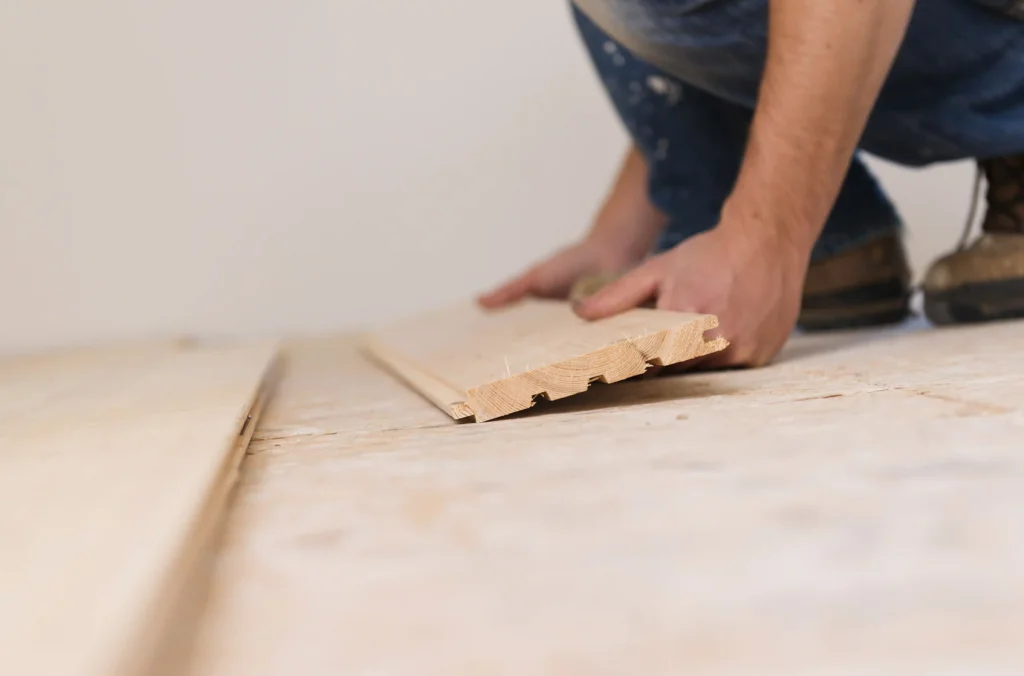
Bamboo flooring expands when indoor humidity rises and contracts when humidity drops — a response governed by its hygroscopic cell structure, not by any manufacturing defect. The degree of movement, and whether it causes lasting damage, depends on the construction type, the installation method, and how consistently indoor conditions are maintained throughout the year.
Bamboo is a grass, not a timber species, but its cellular architecture behaves almost identically to hardwood when exposed to moisture fluctuations. The fibers that run longitudinally through each culm absorb water molecules from the surrounding air, causing the material to swell across its width and, to a lesser but measurable degree, along its length. When that moisture exits — as it does during heated winters or air-conditioned summers — those same fibers release water and the plank shrinks back.
Understanding why this happens, how much movement to expect from each bamboo construction type, and what conditions trigger problems beyond normal seasonal cycling is what determines whether a bamboo floor performs for decades or starts failing within its first few winters.
Why Bamboo Flooring Absorbs and Releases Moisture
Bamboo is hygroscopic, meaning its cellular structure actively exchanges moisture with the surrounding air to reach a state of equilibrium. This property is not a weakness — it is a fundamental characteristic shared by every natural cellulose-based material, including oak, maple, and pine.
The mechanism works as follows: when the relative humidity (RH) of a room rises above the moisture content already held within the bamboo plank, water vapor diffuses into the cell walls, causing them to swell. When room RH falls below the plank’s internal moisture content, the cells lose water and compress. The force this movement generates is substantial enough to pull anchor bolts from concrete if expansion is physically obstructed.
Bamboo flooring reaches its stable equilibrium moisture content (EMC) at approximately 8 to 10 percent moisture content, which corresponds to an indoor relative humidity range of 40 to 60 percent. Inside that range, dimensional movement is minimal and reversible. Outside that range — particularly when humidity drops below 30 percent or exceeds 65 percent — movement becomes pronounced enough to cause structural problems.
Carbonized bamboo, the heat-treated variant that produces darker flooring tones, shows measurably greater dimensional response than natural bamboo under identical humidity conditions. The carbonization process slightly weakens the fiber structure, and independent measurements show carbonized planks averaging approximately 0.4 mm more gap-width change per 10 percent relative humidity swing compared to natural bamboo planks from the same manufacturer.
How Much Bamboo Flooring Actually Moves
The dimensional change in bamboo flooring is directionally asymmetric, meaning movement across the width of a plank far exceeds movement along its length. Scientific analysis of bamboo culm deformation confirms that transverse dimensional changes are significantly larger than longitudinal changes, with longitudinal deformation generally below 0.6 percent — small enough to be ignored in most residential installations.
Width movement, by contrast, is calculable and meaningful at scale. A bamboo floor spanning 4 metres in width can shift up to 23 mm total when a 4 percent change in moisture content occurs across the installation. That figure represents the theoretical maximum, since planks restrain each other across their faces once installed, but it illustrates why expansion gaps at all perimeter walls are a structural requirement, not a precaution.
In practice, a floor installed and maintained within the 40 to 60 percent RH range will move between 2 and 8 mm per 4-metre span across a typical seasonal cycle. Floors installed in uncontrolled environments — seasonal cabins, uncondititioned sunrooms, or homes that swing from 20 percent RH in winter to 75 percent in summer — will experience movement at the upper boundary of that range or beyond.
Unlike most hardwood species, bamboo also expands and contracts measurably along its length. This behaviour is specific to bamboo’s fiber orientation and catches many installers accustomed to hardwood off guard. Expansion gaps must be left at both the sides and the ends of planks, and T-molding transitions must be installed wherever a continuous field of flooring passes through a doorway into another room.
How Construction Type Determines Movement Rate
The three primary bamboo constructions — horizontal, vertical, and strand-woven — each exhibit a distinct dimensional movement profile because their manufacturing processes orient and bind the bamboo fibers differently.
Horizontal Bamboo
Horizontal bamboo is manufactured by stacking flattened bamboo strips on their wide faces in three cross-bonded layers before pressing. This lamination strategy bonds strips from different positions along the original culm together, which partially cancels internal tension between more stable and less stable sections of the plant. The result is a construction that moves more than strand-woven bamboo under humidity changes but shows fewer cupping claims than vertical bamboo because the horizontal lamination distributes moisture absorption across the plank more evenly.
Vertical Bamboo
Vertical bamboo orients the narrow edges of bamboo strips upward in a side-press arrangement, with strips standing closely together before being glued and pressed. Because the dimensional change in vertical bamboo occurs primarily in the thickness direction rather than the width, it has strong resistance to lateral deformation. However, strips taken from higher on the culm — which are less dense and more hygroscopically reactive — are present throughout the board without the cross-bonding benefit of horizontal construction. Horizontal solid bamboo contracts more than vertical bamboo under equivalent moisture loss, making vertical construction slightly more dimensionally stable in seasonal climates.
Strand-Woven Bamboo
Strand-woven bamboo is manufactured by shredding bamboo into individual fibers, saturating those fibers in resin, and compressing the saturated mass under approximately 2,500 tons of cold-press force. This process collapses the cellular structure of the plant and redistributes fiber orientation randomly throughout the compressed block. The result behaves dimensionally like solid hardwood flooring — contracting and expanding at rates comparable to dense domestic species — rather than like traditional bamboo.
Despite this similarity to hardwood, strand-woven bamboo presents a specific acclimation challenge. Because the compressed fiber matrix takes longer to exchange moisture with surrounding air than an open-cell traditional bamboo plank, strand-woven bamboo requires a longer acclimation period before installation. Where a standard horizontal or vertical bamboo floor needs 72 hours of on-site acclimation in normal conditions, strand-woven bamboo may need 5 to 10 days, particularly in climates with high or low baseline humidity. If you are deciding between these constructions for a specific environment, the detailed comparison of how strand-woven and horizontal bamboo behave differently under real conditions covers that decision in full.
The Seasonal Cycle: What Happens Throughout the Year
Bamboo flooring follows a predictable annual expansion-contraction cycle in temperate climates, and recognising this pattern prevents misdiagnosis of normal seasonal movement as product failure.
During spring and summer, indoor relative humidity rises as outdoor air warms and humidifies. The bamboo planks absorb ambient moisture and expand across their width. In a correctly installed floor, this expansion is absorbed by the perimeter expansion gap and released through any T-molding transitions fitted at doorways. The floor may feel slightly tighter underfoot and produce fewer movement sounds as planks press firmly against each other.
During autumn and winter, indoor heating systems reduce relative humidity significantly — sometimes as low as 20 to 25 percent in cold climates. Bamboo releases moisture and contracts. Small gaps between planks, typically under 1 mm in a well-maintained environment, become visible. These gaps are reversible and close again in spring when humidity returns. Gaps wider than 2 to 3 mm indicate that the floor is operating outside its intended humidity range and that active humidity management is needed.
Homes in year-round humid climates — parts of the Gulf Coast or tropical regions where RH stays above 60 percent for most of the year — are less likely to see visible seasonal cycling after the initial acclimation period. However, these environments carry a separate risk: sustained high humidity above 65 percent encourages swelling that exceeds what expansion gaps can absorb, particularly in large open-plan installations without sufficient T-molding breaks. The specific moisture risks that affect bamboo in consistently humid conditions are covered in detail at what moisture actually does to bamboo flooring over time.
What Happens When Expansion Is Obstructed
When bamboo flooring expands and has no physical space to move into, it displaces upward. This is the mechanism behind buckling — a failure mode where planks lift away from the subfloor and form ridges or waves across the surface. Buckling occurs when the expansion gap at the perimeter has been filled, when the floor has been installed without sufficient gap, or when a floating floor has been pinned in place by a heavy fixture bolted to the subfloor through the planks.
Cupping — where the edges of individual planks rise higher than the centre — develops when the underside of the plank absorbs moisture faster than the surface. This typically happens when a moisture source below the floor, such as a damp concrete subfloor or a basement with inadequate vapour control, introduces humidity asymmetrically into the plank. The bottom swells while the top remains drier, creating a concave profile across the board width.
Both failure modes share a common cause: moisture differential that exceeds the floor’s structural tolerance. The expansion gap does not prevent cupping caused by subfloor moisture — it only accommodates lateral movement. If the subfloor introduces moisture from below while the surface remains dry, the plank will cup regardless of whether the perimeter gap is adequate.
Buckling and cupping are explored mechanically in separate articles — the structural causes of bamboo buckling and how cupping develops and whether it reverses — for anyone dealing with either problem.
The Expansion Gap: Size, Placement, and Common Mistakes
The expansion gap is a deliberate void left between the outermost plank and every vertical surface in the room — perimeter walls, door frames, kitchen islands, fireplace surrounds, stair nosings, and any fixed cabinetry. Its function is to provide space for the floor to expand laterally without contacting an immovable object.
Industry standard specifies a minimum expansion gap of 10 mm (approximately 3/8 inch) around the perimeter for standard room widths. Larger installations, particularly those exceeding 8 metres in any direction, require correspondingly larger gaps or additional T-molding breaks mid-floor to prevent the cumulative movement of a large bamboo field from exceeding what a single perimeter gap can absorb.
Baseboards and quarter-round moulding conceal the expansion gap from view after installation. Nailing the baseboard through the flooring plank to the subfloor — a common mistake by installers unfamiliar with floating floor systems — pins the floor and prevents movement. The baseboard must be nailed to the wall, not through the floor.
End-gap mistakes are specific to bamboo and represent a frequent oversight. Installers experienced with hardwood floors may leave side gaps but omit end gaps, not expecting longitudinal movement. Bamboo requires both. Additionally, transition pieces in doorways must be installed as T-moldings — not as fixed thresholds bolted through the plank — to allow the floor on each side of the doorway to move independently. A fixed threshold creates a mechanical pinch point that concentrates expansion stress at the joint, often causing the plank to lift at that location. For a complete breakdown of the mistakes that cause movement-related failures from day one, the article on expansion gap errors and how they damage bamboo floors documents each one specifically.
How Acclimation Controls Post-Installation Movement
Acclimation is the process of allowing bamboo flooring planks to exchange moisture with the room’s ambient air until the plank’s internal moisture content stabilises at the same level as its permanent environment. A floor installed before acclimation is complete will continue to move — expanding or contracting — after it is fixed to the subfloor, which places stress on joints and adhesive bonds that were designed to hold a dimensionally stable plank.
Bamboo flooring leaves the manufacturing facility kiln-dried to approximately 8 to 10 percent moisture content. During ocean freight and warehouse storage, the planks may gain or lose moisture depending on container and warehouse conditions. On site, they must be acclimated in the actual room where they will be installed — not in a garage, corridor, or adjacent space with different humidity characteristics — and the room must already be at its normal occupancy temperature and humidity level before acclimation begins.
The standard acclimation period for horizontal and vertical bamboo in conditions within the 40 to 60 percent RH range is 72 hours minimum. In dry climates where RH regularly stays below 35 percent, 5 days is the minimum. In humid climates where RH exceeds 65 percent, or when acclimating strand-woven bamboo in any climate, 10 to 14 days is the appropriate duration. The moisture content difference between the bamboo planks and the subfloor must be within 3 percent before installation proceeds — a condition verified with a calibrated moisture meter, not estimated by feel or timing alone.
Skipping or shortening acclimation is one of the most consequential installation errors because its effects appear weeks or months after installation, when the connection between the mistake and the outcome is no longer obvious. The full acclimation procedure, including how to verify readiness before installation starts, is detailed at the correct acclimation process for bamboo flooring.
Installation Method and Its Effect on Movement Behaviour
The three installation methods for bamboo flooring — floating, nail-down, and glue-down — produce different movement profiles under the same humidity conditions.
A floating floor functions as a single connected mass. Every plank is locked to its neighbours through the tongue-and-groove or click joint, so the entire floor moves as one unit. In large open spaces, this means the cumulative movement across the whole installation must fit within the perimeter expansion gap. Floating installations are particularly sensitive to humidity swings that exceed 15 percent relative humidity variation across a year, because the total dimensional change of a large floating field can easily exceed a standard expansion gap. Manufacturers typically recommend nail-down or glue-down installation for environments where seasonal humidity variation exceeds 15 to 20 percent.
A glue-down installation bonds each plank individually to the subfloor, distributing movement forces along the adhesive interface rather than accumulating them at the perimeter. This method significantly reduces the risk of buckling in high-humidity conditions, but it also means any moisture that penetrates the subfloor bond line — through a failed moisture barrier or a cracked concrete slab — can cause cupping without the visible warning signs that appear before a floating floor buckles. Glue-down installations over concrete require the subfloor moisture content to test below the manufacturer’s specified threshold, typically measured at under 3 pounds per 1,000 square feet per 24 hours using a calcium chloride test, before adhesive is applied.
Nail-down installation is appropriate for bamboo installed over wood subfloors above grade and produces movement characteristics between floating and glue-down. The mechanical fasteners allow limited lateral movement at each nail point while preventing gross displacement. For environments with moderate seasonal humidity variation, nail-down delivers a good balance between accommodation of movement and resistance to buckling. The specific tradeoffs between each method for bamboo are laid out at how floating and glue-down installation compare for bamboo.
Maintaining Humidity to Prevent Abnormal Movement
The most effective control over bamboo flooring movement is maintaining indoor relative humidity within the 40 to 60 percent range consistently across all seasons. This range keeps bamboo at or near its equilibrium moisture content and limits the seasonal cycling to small, cosmetically invisible movements.
In winter, central heating systems reduce indoor RH dramatically, sometimes to 20 percent or below in very cold climates. A whole-house humidifier connected to the HVAC system maintains humidity more consistently than portable room humidifiers, which create humidity gradients across a house that can generate differential movement between connected rooms. Target a minimum winter indoor RH of 35 percent for bamboo floors in heated climates.
In summer, air conditioning reduces RH passively. Homes in humid coastal or tropical climates where outdoor RH frequently exceeds 70 percent may require a dehumidifier to keep indoor RH below 60 percent. A bamboo floor exposed to sustained RH above 65 percent will absorb moisture beyond its expansion gap’s accommodation capacity and may swell into the walls or lift at seams.
A digital hygrometer placed in the room with the bamboo floor provides ongoing monitoring data and costs under $20 at any hardware retailer. Tracking the RH over a full annual cycle before installing bamboo flooring gives an accurate picture of how much the environment fluctuates and whether active humidity control is needed. In environments where RH cannot be controlled — unheated outbuildings, sunrooms without climate control, or basement spaces with persistent ground moisture — bamboo flooring is a poor choice regardless of construction type. The environments where bamboo flooring consistently fails covers all the structural and environmental situations where this material should not be used.
Does Engineered Bamboo Move Less Than Solid Bamboo?
Engineered bamboo flooring places a bamboo wear layer over a plywood or HDF core. The cross-ply construction of the core layers resists dimensional change more effectively than a solid bamboo plank because each layer’s grain direction opposes the movement tendency of the layers above and below it. This cross-ply resistance reduces the total movement of the board under a given humidity change by approximately 50 to 70 percent compared to solid bamboo of equivalent width.
Engineered bamboo also tolerates a wider range of subfloor conditions and can be installed in environments — including over radiant heating systems and over concrete slabs with moderate moisture readings — where solid bamboo would carry unacceptable risk. The wear layer is thinner than a solid plank, which limits refinishing options, but for humid or thermally variable environments, the dimensional stability advantage outweighs that limitation for most homeowners.
The structural and performance differences between solid and engineered constructions — including how movement profiles diverge under real installation conditions — are analysed at what separates solid from engineered bamboo flooring.
Normal Movement vs. a Problem That Needs Fixing
Not every dimensional change in bamboo flooring requires intervention. Understanding the threshold between normal hygroscopic behaviour and a condition that will cause lasting damage prevents unnecessary repair work and correctly identifies when action is genuinely needed.
Normal movement produces gaps of under 1 mm between planks during winter contraction, a slight tightening of the floor during summer expansion, and occasional low-amplitude creaking as planks shift against each other at temperature transitions. All of these reverse with the next seasonal change and leave no structural trace.
Movement that requires attention produces gaps wider than 2 to 3 mm that persist beyond one full seasonal cycle, visible ridging or buckling at plank seams, cupped planks that do not flatten when humidity is restored, or planks that have separated at the tongue-and-groove joint. Any of these indicate either that the floor was installed without adequate expansion space, that the humidity environment exceeds the floor’s design tolerance, or that a subfloor moisture source is introducing moisture asymmetrically.
Bamboo flooring that has buckled due to obstructed expansion typically cannot be reversed — the plank has been permanently stressed beyond its elastic limit. Cupping caused by temporary moisture exposure can sometimes reverse on its own once the moisture source is removed and the floor dries uniformly, but cupping that has been present for more than a few weeks tends to set permanently. The repair options available for each movement-related problem, and the point at which replacement becomes the only viable path, are covered at how to assess and fix bamboo flooring movement problems.
The Single Factor That Controls Every Outcome
Bamboo flooring’s dimensional movement is not a manufacturing defect, a quality indicator, or an avoidable characteristic — it is an intrinsic property of a hygroscopic material, identical in mechanism to the behaviour of every other natural wood-based floor. The variable that determines whether that movement remains invisible and reversible or escalates into cupping, buckling, and joint failure is humidity control. A bamboo floor installed correctly, acclimated fully, fitted with adequate expansion gaps, and maintained within a 40 to 60 percent relative humidity range will cycle through seasonal movement for decades without any sign of distress. The same product installed in a space where humidity swings from 20 percent to 75 percent across a year will fail regardless of brand, grade, or construction type.
Choosing the right bamboo construction for a specific climate is the second decision point. Strand-woven bamboo’s collapsed cell structure gives it the closest dimensional stability to hardwood and the best performance in environments with moderate humidity variation. Engineered bamboo’s cross-ply core delivers the strongest resistance of any bamboo product. For high-humidity climates specifically, how strand-woven bamboo performs in persistently humid environments addresses whether even the most stable bamboo construction can hold up where RH consistently tests above 65 percent.