Bamboo flooring plank thickness ranges from 10mm to 15mm depending on construction type, and each measurement carries specific consequences for installation method, subfloor compatibility, refinishing potential, and door clearance. Thickness does not determine hardness, color, or visual appearance — those attributes are fixed during manufacturing and finishing, independent of how deep the plank is cut.
The three main construction types — solid horizontal/vertical bamboo, strand woven bamboo, and engineered bamboo — each occupy a defined thickness range. Selecting the wrong thickness for a given subfloor or installation condition is one of the most common technical mistakes in bamboo floor projects, and it frequently voids manufacturer warranties.
What Bamboo Flooring Thickness Measures and What It Does Not
Bamboo flooring thickness is the total plank depth measured from the top surface to the bottom face, expressed in millimeters. It does not include underlayment, adhesive, or any subfloor material. In engineered bamboo, the total thickness is subdivided into three distinct functional layers: the bamboo wear layer on top, a composite core in the middle, and a backing layer at the base.
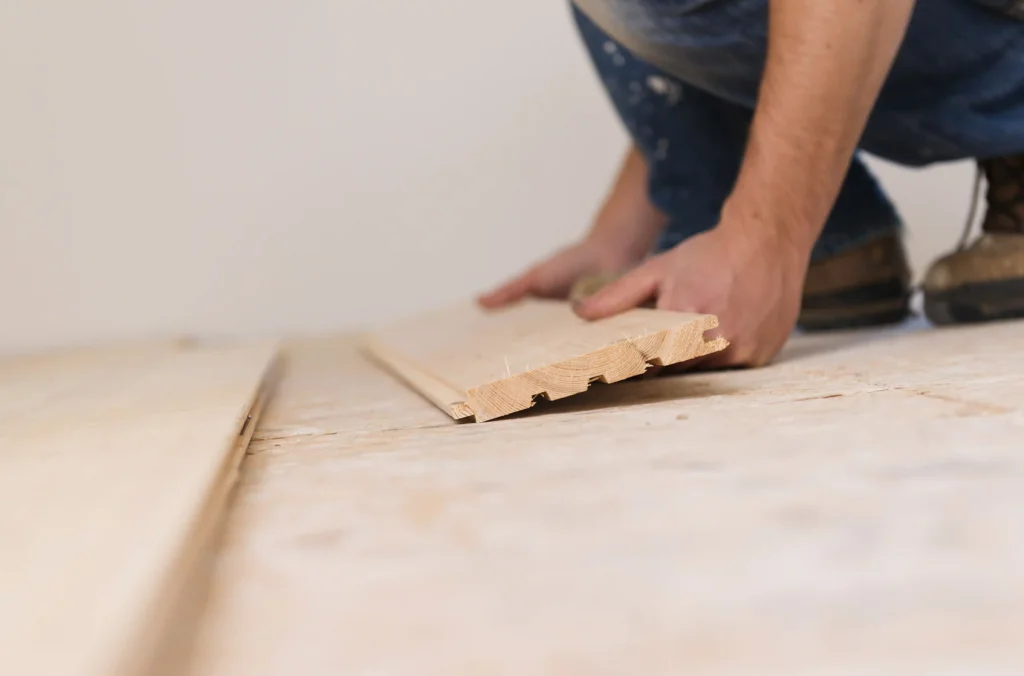
The tongue-and-groove profile machined into plank edges does not alter the structural thickness reading. Manufacturers always measure thickness at the flat center section of the plank, not at the tongue or groove point.
Thickness does not control hardness. Bamboo flooring hardness is determined by construction type and fiber compression during manufacturing. A 10mm strand woven plank and a 14mm strand woven plank of identical construction will score identically on the Janka hardness scale. The relationship between construction type and Janka scores explains why strand woven bamboo at any thickness outperforms solid horizontal bamboo at any thickness.
Wear layer thickness, not total thickness, governs refinishing potential. In solid bamboo, the entire plank depth is bamboo fiber and therefore available for sanding. In engineered bamboo with a 4mm wear layer, only those 4mm are available before the composite core is exposed.
Standard Thickness Ranges by Construction Type
Solid horizontal and vertical bamboo has a standard residential thickness of 15mm, with a 10mm variant produced specifically for radiant heat installations. Strand woven bamboo is manufactured at 14mm as the market standard, with 12mm and 10mm available for specific installation requirements. Engineered bamboo is produced at a fixed 14mm total depth consisting of a 4mm bamboo wear layer, an 8mm HDF or composite core, and a 2mm backing layer.
| Construction Type | Standard Thickness | Wear Layer | Refinishable |
|---|---|---|---|
| Solid Horizontal / Vertical | 15mm (10mm for radiant heat) | Full plank depth | Yes — up to 8–10 times |
| Strand Woven Solid | 14mm (12mm and 10mm available) | Full plank depth | Limited — extremely hard surface |
| Engineered Bamboo | 14mm fixed | 4mm bamboo veneer | Yes — 2 to 3 times |
Planks at 17mm and 18mm exist in limited international markets, produced in Jiangxi and Hunan provinces in China from less precisely cut bamboo strips. These thicker variants are not considered industry standard in Western export markets and carry no refinishing or structural advantage over 15mm solid bamboo.
Understanding how solid and engineered bamboo differ in construction helps clarify why these thickness standards developed differently — each construction method places different structural demands on plank depth.
How Thickness Determines Installation Method Compatibility
Installation method compatibility is the most consequential practical effect of bamboo flooring thickness. Each thickness range aligns with specific subfloor types and fastening systems, and choosing a thickness incompatible with the subfloor is a leading cause of floor failure within the first two years.
15mm solid bamboo requires nail-down installation using cleats or staples over a plywood subfloor with a minimum 18mm depth. Glue-down installation over concrete is possible at 15mm but requires a tested moisture vapor barrier and a spread rate adhesive of at least 2mm thickness. Floating installation is not recommended for 15mm solid bamboo due to excessive movement potential across the plank width.
14mm strand woven bamboo is the most installation-flexible thickness option. It supports nail-down, glue-down, and floating click-lock installation across both plywood and concrete subfloors. This versatility makes 14mm strand woven the preferred thickness in renovation projects where subfloor type is uncertain.
10mm engineered bamboo is optimized for floating installation. The cross-laminated core structure resists lateral movement, making 10mm engineered bamboo the standard specification for radiant heat systems and concrete subfloors in below-grade applications. Nail-down installation is not recommended at 10mm because the reduced plank depth does not provide sufficient material around the fastener to prevent split failure.
Concrete subfloors require a moisture vapor emission test before any bamboo installation regardless of thickness. A reading above 3 lbs per 1,000 square feet per 24 hours using the calcium chloride test requires a polyethylene vapor barrier with a perm rating below 0.13 between the concrete and the bamboo. The full process for installing bamboo over a concrete subfloor covers the testing protocol and barrier requirements in detail.
Why 10mm Is the Maximum Thickness for Radiant Heat Systems
Radiant heating systems generate heat from beneath the floor surface and direct that thermal energy upward through the flooring material. This upward heat flow causes bamboo fiber to expand laterally across the plank width. Planks thicker than 10mm accumulate and release more thermal energy per cycle, increasing the dimensional change beyond the tolerances most manufacturers warrant.
The 10mm threshold exists because bamboo fiber expansion across plank width at this depth remains within specified tolerances when floor surface temperature stays at or below 27°C (80°F). Planks thicker than 10mm operating above this surface temperature exceed those tolerances, producing joint opening, cupping, or buckling over time.
Engineered bamboo at 10mm outperforms solid bamboo at 10mm in radiant heat applications. The cross-laminated core — where the HDF or composite substrate layers run perpendicular to the bamboo wear layer — counteracts directional thermal expansion, reducing total movement by up to 50% compared to unidirectional solid construction at the same thickness.
Nail-down installation is prohibited over radiant heat tubing regardless of bamboo thickness. Fasteners driven through the plank into a concrete subfloor risk puncturing hydronic tubing. Glue-down using a vapor-lock adhesive at a minimum 2mm spread rate is the required method for solid bamboo over radiant heat. Floating installation with a closed-cell IXPE underlayment of at least 2mm is the standard method for engineered bamboo over radiant heat.
The radiant heat system must operate at its maximum output temperature for 5 to 6 consecutive days before bamboo flooring acclimation begins. Skipping or shortening the acclimation period before installation on radiant heat is a primary cause of buckling and joint separation within the first heating season.
How Thickness Raises Floor Height and Affects Door Clearance
Bamboo flooring raises the finished floor height by the combined sum of plank thickness plus underlayment thickness. A 10mm plank installed over a 3mm underlayment produces a 13mm total floor rise. A 15mm plank over the same underlayment produces an 18mm rise. This 5mm difference determines whether existing interior doors require the bottom rail trimmed before reinstallation.
| Plank Thickness | Underlayment | Total Floor Rise | Door Trim Typically Needed? |
|---|---|---|---|
| 10mm | 3mm | 13mm | Rarely |
| 12mm | 3mm | 15mm | Check clearance — borderline |
| 14mm | 3mm | 17mm | Likely in most rooms |
| 15mm | 3mm | 18mm | Yes — standard trim required |
Measure the gap between the bottom of each door and the existing finished floor surface before selecting a thickness. When that gap is less than 20mm, a 15mm plank with underlayment will contact the door during operation. In renovation projects where existing flooring is removed before installation, the total available gap increases by the depth of the material removed.
Transition thresholds between rooms, reducer strips at doorways, and stair nosings all carry height constraints that interact with bamboo plank thickness. In kitchens adjoining living rooms where tile meets bamboo, the combined height of both flooring systems must align within 6mm to avoid a trip hazard at the threshold.
What Thickness Means for How Many Times You Can Refinish the Floor
Refinishing removes a thin layer of surface material to eliminate scratches and worn finish, then applies a new protective coating. The number of refinishing cycles a floor supports depends entirely on the depth of bamboo fiber available above the structural tongue-and-groove joint.
Solid horizontal and vertical bamboo at 15mm provides the highest refinishing potential of any bamboo construction type. Each sanding pass removes approximately 0.2mm to 0.3mm of material. A 15mm solid plank supports 8 to 10 refinishing cycles before material depth approaches structural limits.
Engineered bamboo refinishing is constrained by the 4mm wear layer. After 2 to 3 passes, the wear layer depth approaches the adhesive line bonding the bamboo veneer to the composite core. Sanding below this point exposes the core material, which cannot accept conventional floor finish.
Strand woven bamboo at 14mm is technically the full plank depth, but the extreme surface hardness of compressed bamboo fiber — scoring 3,000 to 4,000 lbf on the Janka scale — requires industrial belt sanders for refinishing rather than standard drum sanders. Most manufacturers rate strand woven products for 1 to 2 refinishing cycles under residential use. In practice, strand woven bamboo resists scratching at a rate that means refinishing is rarely required within a 20-year residential lifespan.
Whether bamboo flooring can be refinished at all depends on construction type before it depends on thickness — that distinction matters when comparing products priced similarly but built differently.
How Bamboo Flooring Thickness Compares to Hardwood Standards
The North American standard for solid hardwood flooring is 19mm (3/4 inch). This historical thickness developed because softer wood species required depth to provide structural rigidity under load and sufficient material for multiple refinishing cycles. Bamboo fiber density removes both requirements that drove the hardwood standard.
| Flooring Type | Thickness | Janka Score (lbf) | Refinishing Cycles |
|---|---|---|---|
| Red Oak Hardwood | 18–19mm | 1,290 | 5–7 |
| Hickory Hardwood | 18–19mm | 1,820 | 4–6 |
| Solid Horizontal Bamboo | 15mm | ~1,825 | 8–10 |
| Strand Woven Bamboo | 14mm | 3,000–4,000 | 1–2 |
A 15mm solid bamboo plank delivers equivalent structural rigidity to an 18mm oak plank because bamboo cellulose fibers are more tightly packed and oriented along the load-bearing axis. The density differential compensates for the 3mm to 4mm reduction in plank depth.
Strand woven bamboo at 14mm outperforms every standard hardwood at 18mm to 19mm in surface hardness. The 4,000 lbf Janka measurement of some strand woven products places them above Brazilian cherry (2,820 lbf) and hard maple (1,450 lbf). The full hardness comparison between strand woven bamboo and hardwood flooring species breaks down the performance gap across impact resistance, scratch resistance, and dent depth.
Which Thickness to Avoid for Specific Subfloor Conditions
15mm solid bamboo should not be installed over concrete subfloors without a tested damp-proof membrane. Moisture emitting from the concrete surface absorbs into the full 15mm plank depth, causing the planks to expand vertically and produce cupping — where the plank edges rise above the center. This failure mode develops over weeks, not years, when moisture barriers are omitted.
15mm solid bamboo should not be installed over any radiant heating system regardless of installation method. Thermal cycling at this plank depth generates dimensional movement that exceeds the rated tolerances of tongue-and-groove joinery, producing recurring gaps during the heating season.
Thin 10mm click-lock products installed via the floating method require a subfloor flat to within 3mm per 1.8 meters (3/16 inch per 6 feet). Deviations beyond this tolerance create unsupported spans beneath the plank where the click-lock joint bears the full deflection load, causing joint fatigue and audible hollow spots within 12 to 18 months.
| Subfloor Condition | Thickness to Avoid | Failure Risk | Correct Alternative |
|---|---|---|---|
| Concrete without moisture barrier | 15mm solid | Cupping, joint separation | 14mm engineered with polyethylene barrier |
| Radiant heating system | 15mm solid, 14mm solid | Buckling, seasonal gaps | 10mm engineered, cross-laminated |
| Uneven subfloor (>3mm per 1.8m) | 10mm floating click | Hollow spots, joint fatigue | Level first; use glue-down installation |
| Basement below grade | 15mm solid horizontal | Seasonal expansion, cupping | 14mm engineered, glue-down |
Basement and below-grade installations present the highest subfloor moisture risk regardless of geographic climate. Relative humidity fluctuations between summer and winter cause repetitive expansion and contraction cycles that 15mm solid bamboo absorbs more severely than 14mm engineered bamboo with a stabilizing cross-laminated core. Environments where bamboo flooring consistently underperforms include below-grade spaces precisely because thickness selection alone cannot compensate for ambient moisture variability.
How Thickness Affects Commercial Flooring Specifications
14mm strand woven bamboo is the standard specification for commercial bamboo flooring applications because it combines peak surface hardness with installation flexibility across concrete and plywood subfloors. Glue-down installation of 14mm strand woven over concrete is the method preferred by commercial installers because it eliminates the joint movement and click-lock fatigue that floating installations develop under sustained heavy foot traffic.
High-traffic retail and hospitality environments require a subfloor flatness tolerance of 3mm per 1.8 meters. Deviations outside this range produce hollow spots and joint stress that propagate into audible floor movement within the first year of commercial use, regardless of bamboo plank thickness.
15mm solid horizontal or vertical bamboo is appropriate for lower-traffic commercial environments — offices, studios, and consultation spaces — where controlled humidity and minimal point-load stress from display or production equipment are maintained. The extended refinishing potential of 15mm solid bamboo provides a long-term cost advantage in commercial settings where periodic floor restoration is budgeted.
Aluminum oxide finish applied over any commercial bamboo thickness adds an abrasion resistance layer that extends the surface life between refinishing cycles. A 25-micron aluminum oxide coating on a 14mm strand woven plank resists abrasion up to 5,000 revolutions on the Taber abrader test, compared to 1,500 to 2,000 revolutions for standard polyurethane finish.
How Thickness Affects Material Cost Per Square Meter
Thicker bamboo flooring costs more per square meter because greater plank depth requires proportionally more raw Moso bamboo during production. A 15mm solid bamboo plank contains 50% more bamboo fiber than a 10mm plank of the same width and length. This raw material difference flows directly into unit price.
Engineered bamboo at 14mm costs less than solid bamboo at 15mm despite matching or exceeding it in installation versatility. The 14mm total depth includes only 4mm of bamboo fiber in the wear layer — the remaining 10mm consists of composite core (HDF, poplar, or rubberwood) at a fraction of the bamboo raw material cost.
Thin strand woven click-lock bamboo at 10mm to 12mm represents the lowest cost per square meter among solid bamboo constructions. The compressed strand manufacturing process achieves maximum hardness from a minimal material volume, making it cost-efficient without sacrificing surface performance.
Thickness is a weaker price driver than Moso bamboo grade and manufacturing precision. Two 15mm solid bamboo planks from different suppliers can differ by 40% to 60% in price based on Moso culm age at harvest, strip cutting precision, and adhesive formulation. The structural differences between budget and premium bamboo flooring are more directly tied to raw material grade than to thickness specification.
What Thickness to Choose Based on Room and Use Case
Living rooms and dining rooms on a plywood subfloor without radiant heat are suited to 15mm solid horizontal or vertical bamboo where maximum refinishing potential is the priority, or 14mm strand woven solid where surface durability under furniture movement is the priority.
Kitchens require a bamboo thickness compatible with glue-down installation because of elevated moisture exposure from cleaning, spills, and humidity from cooking. 14mm engineered bamboo glued down over a moisture-tested subfloor performs more predictably in kitchen environments than 15mm solid bamboo, which responds more aggressively to moisture cycling from below.
Bedrooms present the lowest-stress use case for thickness selection. 14mm engineered floating bamboo delivers sufficient durability for bedroom foot traffic while minimizing floor height increase — an advantage in rooms with fitted wardrobes where door clearance is already constrained.
Home offices and studios with rolling chair traffic benefit from 14mm strand woven bamboo because castor wheel contact generates concentrated point loads that hollow, softer constructions dent over months of daily use. The 3,000 to 4,000 lbf Janka rating of strand woven bamboo at 14mm resists castor-induced indentation that solid horizontal bamboo at 15mm does not.
Entryways and hallways, which sustain the most abrasive foot traffic in residential settings, perform best with 14mm strand woven bamboo at any installation method. The combination of surface hardness and sufficient plank depth for at least one refinishing cycle provides the longest practical service life in these transitional spaces. The room-by-room breakdown of where bamboo flooring performs reliably covers the interaction between traffic patterns, humidity exposure, and construction type across the full residential floor plan.
The Single Most Important Thickness Decision
The correct bamboo flooring thickness is not determined by aesthetics or budget alone — it is determined first by subfloor type and heating system, then by refinishing expectations, and finally by door clearance constraints. A 15mm solid bamboo plank installed in the wrong subfloor condition will fail regardless of its quality. A 10mm engineered plank matched correctly to a radiant heat system will outperform any thicker product installed without regard to thermal compatibility.
Strand woven bamboo at 14mm is the most versatile single thickness choice across installation methods and room types. For radiant heat subfloors, engineered bamboo at 10mm is the only technically sound option. For maximum refinishing longevity over a standard plywood subfloor, 15mm solid bamboo is unmatched.
Thickness selection connects directly to how the floor is installed — the method, the underlayment, the adhesive, and the expansion gap all change depending on which plank depth you choose. Understanding the full range of bamboo flooring installation methods before purchasing prevents the most expensive mistake in bamboo floor projects: buying the right plank for the wrong subfloor.