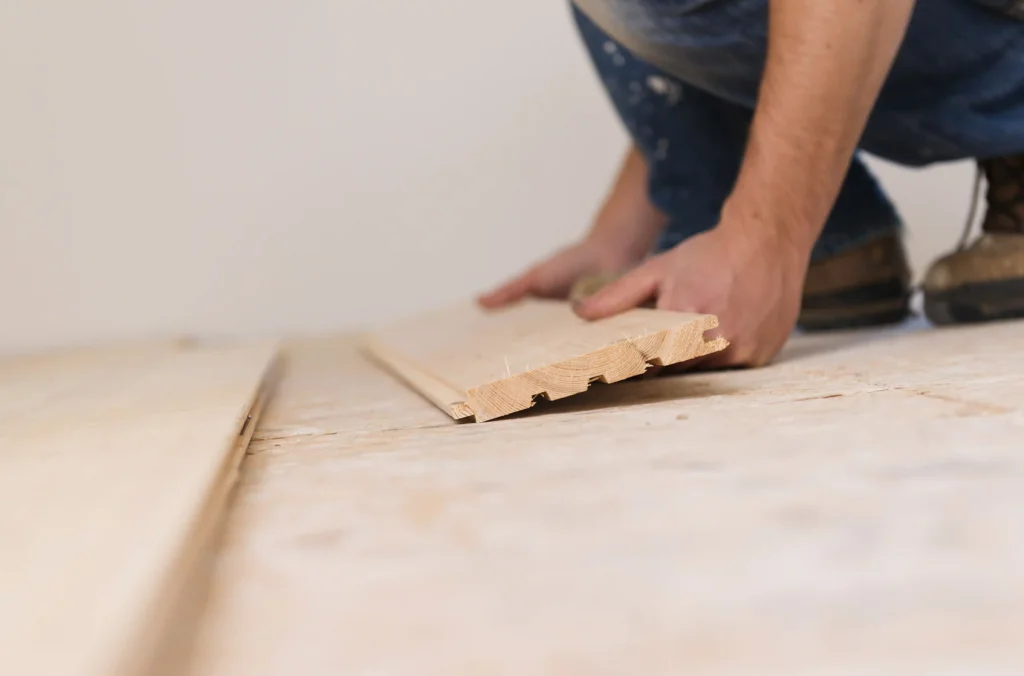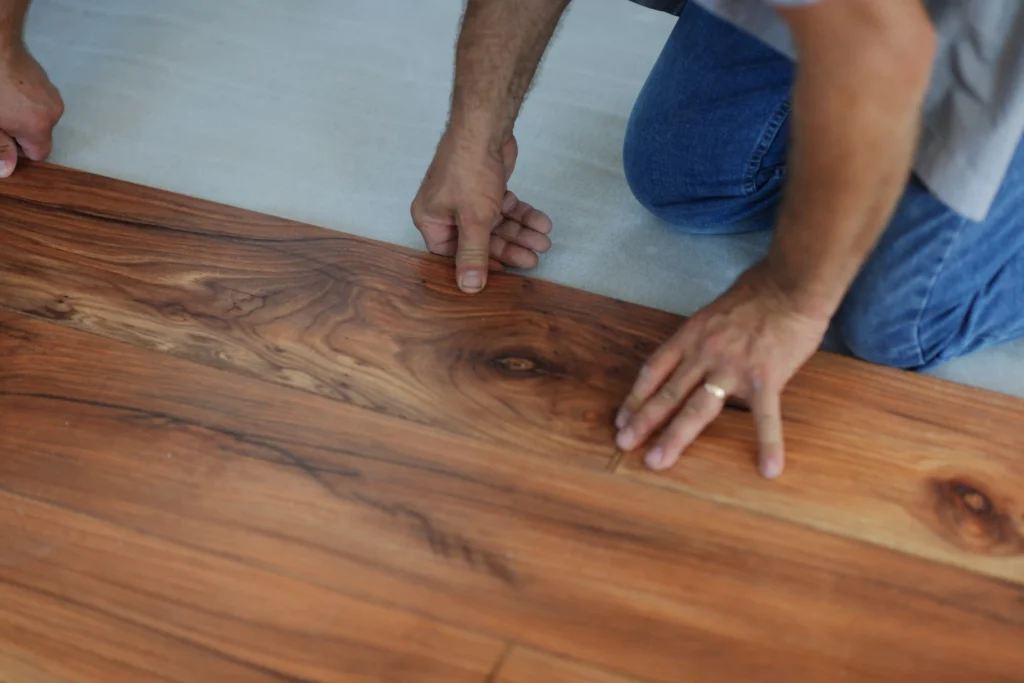
Bamboo flooring divides into three structural types — horizontal, vertical, and strand woven — each produced through a different pressing method that determines hardness, grain pattern, and dimensional stability. Every one of these structural types is then manufactured either as a solid plank or an engineered plank, producing six distinct product configurations that perform differently across installation environments, traffic loads, and humidity conditions. Understanding what separates these types prevents costly mismatches between the product you buy and the floor that actually survives in your home.
How Bamboo Flooring Construction Determines Its Performance
Bamboo flooring planks are not cut from a single stalk the way hardwood is cut from a log. Moso bamboo culms — the hollow stems harvested at four to six years of maturity — are split, stripped of their outer skin, and processed into narrow rectangular strips. Those strips are then assembled in one of three orientations under heat and pressure, which is the single most important manufacturing decision affecting the final product’s hardness, visual grain, and movement behavior.
The pressing orientation determines how the nodes (the natural knuckle-like joints along the bamboo stalk) appear on the floor surface. It also determines the structural density of the plank and, in turn, how the floor responds to moisture-driven expansion and contraction. Before choosing a finish, color, or price point, identifying the correct construction type for your specific subfloor and environment produces better long-term results.
What Is Horizontal Bamboo Flooring and How Is It Made
Horizontal bamboo flooring is produced by stacking bamboo strips flat — with their wide faces facing upward — and laminating them together in layers using adhesive and heat. This orientation exposes the full width of each strip on the surface, making the natural nodes (knots) of the bamboo visibly prominent across the face of the plank.
The resulting grain pattern is wide, organic, and irregular. Because each layer runs in the same direction and the nodes appear at intervals along the surface, horizontal bamboo most closely resembles the visual character of traditional hardwood, with pronounced figuring that varies plank to plank. Manufacturers typically laminate three to four layers to reach a standard finished thickness of 15mm for solid horizontal bamboo.
In its natural (non-carbonized) state, horizontal bamboo registers a Janka hardness rating of approximately 1,380 lbf, which is comparable to white oak at 1,360 lbf. The carbonized version — produced by steaming the strips under pressure before assembly to caramelize the natural sugars in the fibers — drops to between 1,000 and 1,100 lbf, placing it in the range of Douglas fir and American cherry. For kitchens and high-traffic hallways, carbonized horizontal bamboo dents more readily than its natural counterpart, and this hardness reduction is a practical consideration rather than a cosmetic one.
Horizontal bamboo installs via nail-down, glue-down, or floating methods over most standard subfloor types. Its multi-layer construction makes it compatible with both concrete and timber subfloors, provided the acclimation requirements are observed. For a detailed understanding of how bamboo flooring acclimation works and why it directly affects horizontal bamboo’s dimensional stability, that process is a non-negotiable prerequisite before installation.
What Is Vertical Bamboo Flooring and How It Differs Structurally
Vertical bamboo flooring is made by rotating the bamboo strips 90 degrees so they stand on their narrow edges, facing upward, before being laminated side by side. This orientation hides the nodes within the compressed joint lines, pushing them to the interior of the plank rather than displaying them across the surface.
The visual result is a narrow, uniform grain that runs linearly down the length of the plank with minimal variation between boards. Vertical bamboo produces a cleaner, more contemporary aesthetic than horizontal bamboo, and its surface regularity makes it a common choice for open-plan spaces where visual continuity across a large floor area matters.
Because vertical bamboo uses a 1-ply structure — strips standing together in a single compressed layer rather than multiple stacked layers — it is mechanically different from horizontal bamboo despite using identical raw material. The Janka hardness rating for natural vertical bamboo sits at approximately 1,380 lbf, identical to horizontal bamboo in natural form. Carbonized vertical bamboo drops to a similar range of 1,000 to 1,100 lbf for the same reason: the caramelization process that creates the darker amber-to-brown color weakens the fiber density regardless of strip orientation.
Vertical bamboo performs well in large commercial and public spaces specifically because the narrow grain creates near-uniform color distribution across hundreds of square feet, eliminating the tonal patchwork that can appear with horizontal bamboo in wide open installations.
What Is Strand Woven Bamboo Flooring and Why Its Manufacturing Process Is Fundamentally Different
Strand woven bamboo flooring is not a laminated strip product. Instead of assembling intact bamboo strips in a parallel orientation, the manufacturing process begins by shredding the bamboo stalks into individual fiber strands. Those strands are dried, saturated with adhesive resin in a glue tank — the shredded state allows resin to penetrate deeply into the bamboo fiber rather than coat only the surface — and then compressed under 2,500 tons of cold pressure followed by a curing process that fuses the material into a solid, dense block. That block is then sliced into planks and finished with tongue-and-groove profiles and surface coatings.
This compression process interlock the fibers at a molecular level rather than simply bonding strips at their faces. The resulting material achieves a Janka hardness rating of between 3,000 and 5,000 lbf depending on the manufacturer’s formulation and the level of compression applied. To contextualize that figure: red oak rates 1,290 lbf, Brazilian cherry rates approximately 2,350 lbf, and hickory rates 1,820 lbf. Strand woven bamboo outperforms all three common hardwood benchmarks at its upper range.
Strand woven bamboo uses the fiber remnants generated during horizontal and vertical bamboo production, which means the manufacturing process consumes the full bamboo stalk with minimal waste. This characteristic contributes to its lower raw material cost relative to its performance tier. For anyone evaluating strand woven bamboo flooring’s durability in real-world conditions, the compression method directly explains why it outperforms standard laminated bamboo types under foot traffic, furniture load, and pet claws.
The visual grain of strand woven bamboo does not resemble either horizontal or vertical bamboo. The shredding and compression process creates an irregular, flowing figuring pattern with deep tonal variation — often described as resembling exotic hardwood. The surface density also means strand woven bamboo holds finish coatings at a higher film build, contributing to scratch resistance beyond what the Janka rating alone describes.
Natural vs Carbonized Bamboo: How Color Treatment Interacts with Each Construction Type
Bamboo does not accept penetrating stain the way open-grained hardwood does, because its fiber density prevents stain molecules from absorbing into the surface uniformly. Manufacturers achieve color variation through two primary methods: natural finish, which preserves the pale blonde or cream tone of the raw Moso bamboo, and carbonization, which transforms the color through a controlled heat process.
Carbonization subjects the bamboo strips or fibers to high-temperature steam under pressure before final pressing. This heat caramelizes the natural sugars within the bamboo fiber, producing an amber, caramel, or deep tobacco-brown color depending on the duration and intensity of the treatment. The color change is entirely thermal — no dyes or chemical coatings are applied. Light carbonization produces a medium caramel tone; heavy carbonization produces a deep chocolate-brown that closely resembles dark walnut or wenge hardwood.
The structural cost of carbonization is measurable. Natural bamboo (horizontal or vertical) registers 1,380 lbf on the Janka scale. Carbonized versions of the same construction drop to approximately 1,180 lbf — a reduction of roughly 15 to 20 percent. For strand woven bamboo, carbonized versions score between 1,200 and 1,250 lbf compared to 3,000-plus lbf for natural strand woven. The heat treatment applied before compression reduces fiber density at the point of maximum structural development. This means carbonized strand woven, while softer than natural strand woven, still outperforms natural horizontal and vertical bamboo by a significant margin.
A third color option — stained bamboo — applies surface pigment during the finishing stage. Stained bamboo achieves colors outside the natural bamboo palette, including greys, whites, dark espresso tones, and hand-scraped effects. Stained bamboo relies on the surface coating for color rather than the fiber itself, which means refinishing eventually removes the original color if the wear layer is cut through.
Solid Bamboo Flooring: What the Term Actually Means
Solid bamboo flooring consists entirely of bamboo from face to back, with no wood core or substrate layers. Horizontal and vertical solid bamboo planks are constructed by laminating bamboo strips in their respective orientations to a finished thickness of 15mm, sometimes 17mm for domestic markets. Solid strand woven bamboo is available in thicknesses ranging from 3/8 inch (approximately 10mm) to 3/4 inch (approximately 19mm), with 14mm being the standard for residential applications.
Solid bamboo allows refinishing — the surface can be sanded back and recoated when the finish wears through. The number of refinishing cycles available depends on thickness. A 15mm solid horizontal or vertical plank can be refinished two to three times over its service life before the strip geometry is compromised. Solid strand woven bamboo at 14mm supports a similar number of refinishing cycles, though the extreme hardness of the surface requires industrial-grade equipment to sand effectively.
The primary limitation of solid bamboo is its response to moisture-driven dimensional change. Solid planks — particularly horizontal bamboo, where multiple laminated layers can respond to humidity independently — are more susceptible to cupping, gapping, and warping in environments where relative humidity fluctuates outside the 40 to 60 percent range. For subfloors with residual moisture or in climates with wide seasonal humidity swings, this moisture sensitivity is the critical variable that solid bamboo’s construction cannot fully compensate for.
Engineered Bamboo Flooring: How Cross-Lamination Changes the Stability Equation
Engineered bamboo flooring bonds a bamboo wear layer to a multi-layer core substrate, with each layer oriented crosswise to the one above and below it. This cross-lamination principle — the same structural logic used in engineered hardwood and plywood — counteracts the expansion and contraction forces that solid bamboo generates in response to humidity change. When one layer attempts to expand perpendicular to its grain direction, the layer running at 90 degrees to it resists that movement, producing a plank that stays flatter across a wider range of environmental conditions.
The core material in engineered bamboo varies by manufacturer and price tier. Entry-level products use MDF (medium-density fiberboard) cores, which provide dimensional stability under normal conditions but are vulnerable to moisture penetration if the surface coating is compromised. Mid-range products use plywood or poplar cores with alternating grain directions. Premium engineered bamboo uses bamboo plywood cores, maintaining bamboo material through the full depth of the plank. Some performance-oriented products use stone plastic composite (SPC) cores for maximum moisture resistance in bathrooms, laundry rooms, and basements.
The wear layer thickness of engineered bamboo determines refinishability. Thin veneers of 0.5mm to 2mm cannot be sanded without cutting through to the core, meaning the floor cannot be refinished and must be replaced when the surface finish fails. A wear layer of 4mm supports two to three refinishing cycles. The standard engineered bamboo wear layer thickness for a refinishable product is 4mm over a 10mm core, producing a total plank thickness of 14mm.
Engineered bamboo installs over radiant heat systems where solid bamboo cannot, because the cross-laminated core distributes thermal stress across multiple layers rather than concentrating it within a single solid material. For concrete subfloors, glue-down engineered bamboo eliminates the seasonal movement that floating solid bamboo produces over hard, dimensionally stable substrates.
Solid vs Engineered Bamboo: Which Construction Suits Which Installation Condition
Solid bamboo suits timber subfloors at or above grade in climates with stable year-round humidity — typically between 40 and 60 percent relative humidity. It suits homeowners who prioritize refinishing potential and want 100 percent bamboo material through the full plank depth. Nail-down installation on plywood subfloors is the optimal method for solid horizontal and vertical bamboo, providing mechanical fastening that resists seasonal movement rather than relying on adhesive or floating profile locks.
Engineered bamboo suits concrete subfloors, below-grade installations, and rooms with radiant underfloor heating. It suits climates with wide humidity fluctuation where solid bamboo would gap in winter and swell in summer. Glue-down engineered bamboo over concrete provides the combination of dimensional stability and mechanical bonding that those subfloor conditions require. The floating installation method with a click-lock profile suits engineered bamboo in living rooms and bedrooms where full adhesive application is not practical.
For a direct technical comparison of the two construction categories, the analysis of solid vs engineered bamboo flooring covers installation compatibility, refinishing potential, and subfloor requirements in detail.
Strand Woven vs Horizontal vs Vertical Bamboo: Performance Comparison Across Key Metrics
Janka hardness separates strand woven bamboo from horizontal and vertical bamboo by a factor of two to three. Natural horizontal and vertical bamboo register 1,380 lbf. Natural strand woven bamboo registers between 3,000 and 5,000 lbf depending on manufacturer. For households with dogs, high foot traffic, or office-use environments, this difference in dent and scratch resistance is decisive.
Moisture response follows a different hierarchy. Horizontal bamboo, with its multi-layer stack construction, accumulates the dimensional movement of each laminated layer when humidity changes, making it the most reactive of the three types to moisture fluctuation. Vertical bamboo’s 1-ply structure responds more uniformly but still expands and contracts measurably. Strand woven bamboo’s compressed fiber matrix — where adhesive resin is distributed throughout the full cross-section of the plank rather than only at the bond lines — slows moisture uptake and produces smaller dimensional movement per percentage change in relative humidity.
Aesthetic grain character differs categorically across the three types. Horizontal bamboo delivers a bold, organic grain with visible nodes — the closest visual parallel to traditional hardwood character. Vertical bamboo produces a linear, minimal grain pattern suited to contemporary and Scandinavian interior styles. Strand woven bamboo produces a flowing, irregular figuring that resembles exotic hardwood species and has no direct visual equivalent in standard bamboo strip products.
Refinishing ease inversely tracks hardness. Horizontal and vertical bamboo sand and refinish with standard flooring equipment. Strand woven bamboo’s extreme surface density requires drum sanders with aggressive grits and significantly more time per square foot, increasing the professional refinishing cost for that product type.
Bamboo Flooring Grade and Finish: How They Interact with Construction Type
Bamboo flooring grade classifies the visual consistency of the planks within a batch. A-grade or select-grade bamboo specifies tight color matching, minimal tonal variation, and no visible defects across the batch. Lower grades or “character grade” planks include wider tonal variation, occasional surface marks from the manufacturing process, and greater board-to-board visual difference.
Grade standards apply independently to each construction type. Grade A strand woven bamboo describes a product with consistent surface figuring and minimal color deviation between planks, not a performance specification. Grade A horizontal bamboo specifies consistent node placement and coloring across the surface strips. Understanding that grade refers to visual consistency rather than structural quality prevents conflating premium appearance with premium durability.
Surface finish options — gloss, semi-gloss, satin, and matte — interact with construction type in ways that affect visible wear patterns. High-gloss finishes applied over horizontal bamboo amplify the natural grain variation but also make light scratches visible against the reflective surface. Matte finishes over strand woven bamboo minimize visible scratching by diffusing reflected light across the irregular fiber surface. Wire-brushed textures on horizontal bamboo create micro-relief in the surface that hides fine scratches and disguises minor denting from foot traffic.
Which Type of Bamboo Flooring Suits Which Room
Strand woven bamboo in natural (non-carbonized) form suits kitchens, hallways, entryways, and commercial spaces where dent resistance and scratch performance under continuous traffic are the primary requirements. Its Janka rating of 3,000 lbf and above means furniture legs, pet claws, and high-heeled footwear cause less surface damage than they would on horizontal or vertical bamboo at 1,380 lbf.
Horizontal bamboo suits living rooms, dining rooms, and bedrooms where the floor receives moderate traffic and the visual priority is a warm, organic grain character that reads like traditional hardwood. The bold node pattern works particularly well in transitional and rustic interior styles where natural material variation is a design feature rather than a flaw.
Vertical bamboo suits open-plan areas, modern apartments, and commercial spaces where visual uniformity across a large floor area is important. Its linear, minimal grain pattern does not interrupt sightlines in contemporary interiors and coordinates with the clean geometry of modern furniture and architectural detailing.
Engineered bamboo — regardless of the wear layer construction type — suits below-grade rooms, concrete subfloors, and any room with radiant underfloor heating. The rooms where solid bamboo should not be installed generally map directly to the rooms where engineered bamboo performs correctly. The analysis of which rooms suit bamboo flooring and which conditions create compatibility problems provides a practical room-by-room breakdown for installation planning.
The Decision Framework: Matching Bamboo Type to Installation Requirements
Three variables determine which bamboo flooring type delivers the best long-term outcome: subfloor material, environmental humidity range, and traffic intensity. Concrete subfloors below grade point toward engineered bamboo with an SPC or plywood core. Timber subfloors above grade in a climate-controlled interior open the full range of solid and engineered options. Environments where relative humidity drops below 35 percent in winter or exceeds 65 percent in summer disqualify solid bamboo in favor of engineered construction, regardless of type.
Traffic intensity selects between strand woven and laminated strip bamboo. Residential bedrooms and low-traffic living rooms tolerate natural or carbonized horizontal and vertical bamboo without accelerated wear. High-traffic corridors, households with large dogs, and commercial spaces require the density of strand woven bamboo to maintain surface integrity across a multi-decade service life.
Visual preference selects between horizontal, vertical, and strand woven aesthetics within the performance tier that environmental and traffic conditions require. Choosing a type based on appearance without first qualifying it against subfloor and humidity conditions is the most common source of premature bamboo flooring failure. For a comprehensive understanding of how bamboo flooring durability varies by type and condition, the performance differences between construction methods become the foundation of every product selection decision.
Conclusion
The six bamboo flooring configurations — solid horizontal, solid vertical, solid strand woven, engineered horizontal, engineered vertical, and engineered strand woven — are not interchangeable products with minor cosmetic differences. Each construction method produces a distinct combination of hardness, dimensional stability, moisture response, aesthetic character, and refinishing capability. Matching the correct type to the subfloor, climate, and traffic conditions of a specific room is what separates a floor that performs for 25 years from one that cups, gaps, or dents within the first three. The next layer of this decision involves understanding how each type’s characteristics translate into concrete cost and installation planning, which the guide to bamboo flooring cost per square foot covers across all major construction categories.