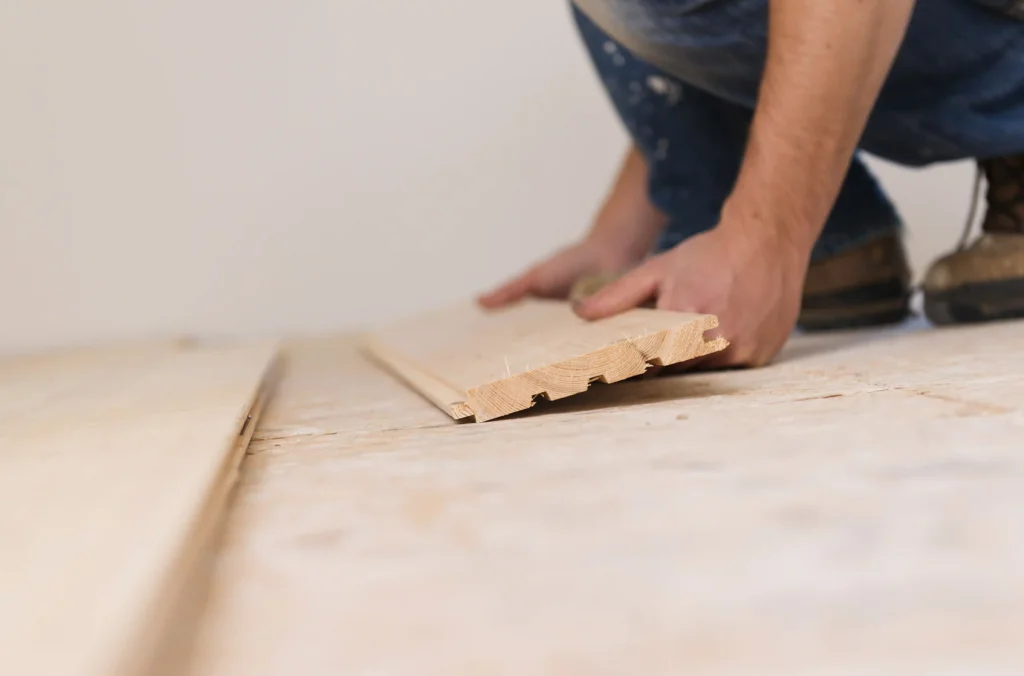
Bamboo flooring fails in predictable ways, and almost all of them trace back to a mismatch between the material’s physical limitations and the environment it gets installed in. Bamboo is a hygroscopic grass-based material that responds to moisture and humidity changes by expanding and contracting at rates that exceed many ring-porous hardwoods. That single characteristic determines most of the situations where it should not be used. Understanding those situations before purchase prevents thousands of dollars in premature replacement.
This page covers the specific conditions, rooms, climates, household situations, and product decisions that make bamboo flooring a poor choice — and explains the mechanism behind each failure so the reasoning is clear, not just the conclusion.
Why Bamboo’s Physical Properties Create Real Limitations
Bamboo is classified botanically as a grass, not a hardwood, and its cellular structure differs from ring-porous species like oak or maple in one critical way: it absorbs and releases atmospheric moisture faster. The National Wood Flooring Association (NWFA) recommends maintaining interior relative humidity between 35% and 55% for most wood flooring installations. Bamboo sits at the sensitive end of that range. When ambient humidity rises above 55% consistently, bamboo planks absorb moisture and swell laterally. When humidity drops below 35% in dry winter months, planks release moisture and contract, producing gaps between boards.
This is not a manufacturing defect — it is physics. The problem arises when homeowners install bamboo in environments where maintaining that 35–55% humidity range is either impractical or impossible. Bathrooms, basements, rooms with large south-facing windows, and climates with extreme seasonal humidity swings all fall into that category.
The second structural limitation is finish depth. Solid horizontal and vertical bamboo planks — the original laminated format — have a compressed grass structure with relatively low density. The Janka hardness rating for standard horizontal bamboo sits around 1,300–1,600 lbf, which is comparable to white oak. Strand-woven bamboo reaches 3,000 lbf, which changes the performance profile significantly, but the finish coat on any bamboo product can still be abraded by grit, pet claws, and dragged furniture legs. Understanding which bamboo type you are evaluating matters before drawing conclusions about durability.
Bathrooms: The Single Worst Location for Bamboo Flooring
A full bathroom generates standing water around the tub and shower apron, steam from hot showers that elevates relative humidity above 80%, and repeated wet-foot traffic. Bamboo flooring absorbs standing water within minutes and begins to swell. Most bamboo flooring warranties are explicitly voided upon installation in full bathrooms. The combination of liquid water on the surface and sustained high ambient humidity creates two simultaneous failure conditions: surface swelling and subfloor moisture migration.
Powder rooms — half-baths without a shower or tub — present a lower risk, but even there, repeated humidity spikes from hand-washing and inadequate ventilation can cause cupping in solid bamboo planks over time. If a bathroom renovation is the goal, porcelain tile or luxury vinyl plank are the appropriate category of product. How bamboo compares to tile on water resistance makes the performance gap between these categories concrete.
Below-Grade Basements With Chronic Moisture
Basements present a moisture problem that originates from below, not above. Concrete slabs emit vapor continuously through a process called hydrostatic pressure, where moisture in the soil migrates upward through the slab. The NWFA sets a maximum moisture emission rate of 3 lbs per 1,000 sq ft per 24 hours for adhesive-down installations. Many residential slabs exceed that threshold, particularly in regions with clay-heavy soil or high water tables.
Engineered bamboo — a format where a bamboo veneer sits over a plywood core — handles below-grade installations better than solid bamboo because the cross-ply plywood core resists dimensional movement. However, engineered bamboo still fails in basements where the slab emits moisture above manufacturer thresholds, where seasonal flooding occurs, or where a functioning dehumidifier is not present. Installing bamboo over a concrete slab without a calcium chloride test first is one of the most common causes of early floor failure.
Solid bamboo — both horizontal and vertical orientation formats — should never be installed in a basement. The plank structure lacks the dimensional stability to withstand the moisture gradient between a damp slab and conditioned air above. How moisture travels through bamboo flooring systems explains why the subfloor condition matters as much as the surface product selected.
Rooms With Direct, Sustained Sunlight Exposure
Bamboo is photosensitive. Prolonged exposure to direct UV radiation causes the surface finish to degrade and the bamboo fibers themselves to change color. Carbonized bamboo — the darker, heat-treated format — tends to lighten under UV exposure. Natural, uncarbonized bamboo yellows. Both changes are permanent without refinishing.
The problem compounds in rooms with large south- or west-facing windows where direct sunlight tracks across the floor for four or more hours daily. Area rugs create sharp color boundaries: the floor beneath the rug retains its original color while the surrounding exposed surface fades. Most manufacturers include UV inhibitors in factory finishes, but those inhibitors degrade over three to five years under sustained direct exposure.
UV-blocking window film reduces solar transmission by 99% for UV wavelengths and delays fading significantly. In rooms where window treatments or UV film are not practical, a flooring material with higher inherent UV stability — such as porcelain tile or colored concrete — eliminates the problem entirely rather than managing it. How UV light damages bamboo flooring over time details the color shift mechanisms and mitigation options.
Climates With Extreme Seasonal Humidity Swings
Coastal climates with summer humidity above 80% RH and continental climates with winter indoor humidity dropping below 20% RH both push bamboo flooring outside its stable operating range. A floor installed in summer at 70% RH and then subjected to winter heating that drops interior humidity to 18% will shrink by enough to produce 1–3mm gaps between every plank run. Those gaps are not repairable without full replacement or refinishing — and they will close again in summer, risking buckling if no expansion gaps were left at perimeter walls.
Climates like the American Midwest and Canadian Prairies experience exactly this cycle annually. Homeowners in these regions who want a wood-look floor need either a flooring material that tolerates wider humidity ranges — engineered hardwood with a thick veneer, luxury vinyl plank, or large-format porcelain tile — or a whole-home humidity control system that maintains 35–55% RH year-round. Installing bamboo without that system in a high-swing climate is installing a floor that will show movement damage within two to three heating seasons.
The floating installation method amplifies this risk. Floating floors — planks clicked together without adhesive or fasteners — move as a connected unit. How bamboo expands and contracts with seasonal humidity changes explains why long floating runs in wide rooms are particularly vulnerable to buckling.
Homes Where the Indoor Humidity Is Not Actively Controlled
Bamboo flooring requires year-round HVAC operation to maintain stable humidity. A vacation home that sits unoccupied for months without climate control, a rental property where tenants control the thermostat inconsistently, or a sunroom addition that is not connected to the main HVAC system all create uncontrolled humidity environments.
In an unoccupied vacation home in a humid climate, interior humidity can reach 90% RH during summer. That level of sustained moisture will cause solid bamboo to cup, warp, and develop mold beneath the planks within a single season. Engineered bamboo fares better but is not immune. For second homes or properties that spend extended periods without climate control, luxury vinyl plank — which is dimensionally stable across a 0–100% RH range — is the appropriate choice.
Rental properties introduce a different version of the same problem. Tenants who disable HVAC systems to reduce utility bills, leave windows open during humid weather, or do not respond promptly to leak notifications all create moisture conditions that bamboo cannot tolerate. The landlord bears the replacement cost when the floor fails.
When Low-Quality Bamboo Raises VOC and Safety Concerns
Bamboo flooring is manufactured using adhesive resins that bond the compressed or laminated bamboo fibers together. The adhesive type determines the VOC off-gassing profile of the finished product. Low-quality manufacturers use urea-formaldehyde (UF) resins, which off-gas formaldehyde into interior air for years after installation. Cheaper bamboo products can emit formaldehyde at concentrations between 0.2 and 0.3 ppm. The California Air Resources Board Phase 2 standard (CARB Phase 2) limits composite wood products to 0.05 ppm. Premium bamboo from certified manufacturers using no-added urea-formaldehyde (NAUF) resins measures below 0.005 ppm.
The gap between a $1.50/sq ft imported bamboo product and a $5.00/sq ft CARB Phase 2-certified product is not just aesthetic — it is a difference in air quality that affects everyone in the home, particularly children and people with respiratory sensitivities. Installing uncertified bamboo flooring in a bedroom, nursery, or school is a bad idea for reasons that have nothing to do with moisture or durability. Look for FloorScore or GREENGUARD Gold certification as minimum verification thresholds. What bamboo flooring VOC certifications actually verify breaks down the certification standards and what each one permits.
Households With Large Dogs or Unmanaged Abrasives
Strand-woven bamboo resists pet claw scratching better than most solid-format bamboo at 3,000 lbf Janka hardness. Standard horizontal and vertical bamboo at 1,300–1,600 lbf does not. A medium-to-large dog with untrimmed claws running across horizontal bamboo flooring will produce visible scratch tracks within weeks. Grit and sand tracked indoors from outdoors acts as abrasive paper under foot traffic, scratching through the factory finish and into the bamboo fibers below.
The critical distinction is bamboo format. Standard laminated bamboo — the kind sold at low price points — scratches easily. Strand-woven bamboo scratches at rates comparable to harder domestic hardwoods. Buying the wrong format for a household with active pets produces a floor that looks worn within 18 months. How strand-woven bamboo performs in homes with pets covers the scratch resistance difference and what protective measures extend finish life.
Households with dogs should also consider that bamboo produces no traction benefit — its smooth factory finish is as slippery as hardwood for dogs, which causes joint stress over time. Tile, textured luxury vinyl, or area rugs over bamboo partially address the traction issue, but the surface remains fundamentally hard and slick.
Spaces Where Refinishing Flexibility Matters
Solid hardwood can be sanded and refinished six to eight times over its lifespan because the wear layer is the full thickness of the plank — typically 3/4 inch. Solid horizontal and vertical bamboo can be lightly sanded and refinished once or twice before the surface layer becomes too thin. Engineered bamboo with a 2–3mm veneer cannot be meaningfully refinished at all — sanding through the veneer exposes the plywood core beneath.
Strand-woven bamboo occupies a middle position: its compressed-fiber structure is dense enough to allow one or two refinishing cycles, but the process requires professional equipment because the extreme hardness at 3,000 lbf dulls standard drum sander belts rapidly.
In a home where flooring longevity through refinishing is a priority — a historic property, a high-end renovation, or a space where the floor will experience heavy use over decades — solid hardwood species like white oak at 1,360 lbf or hard maple at 1,450 lbf offer more refinishing cycles from a comparable hardness range. Bamboo’s refinishing limitations are not a deal-breaker in most residential contexts, but they become relevant when comparing 25-year total cost of ownership.
High-Moisture Kitchens Without Adequate Spill Management
Kitchens present a different moisture risk profile than bathrooms: the moisture is episodic rather than continuous, but it concentrates at the dishwasher, sink, and refrigerator water line — all locations where slow leaks go undetected for weeks. A slow dishwasher door seal leak deposits 0.5–2 liters of water per cycle onto the subfloor area. Bamboo planks in that zone absorb water from below, cup upward at the edges, and develop the characteristic raised ridge that signals internal moisture damage.
Bamboo can survive in a kitchen where spills are wiped immediately, the dishwasher and refrigerator lines are inspected annually, and the space has adequate ventilation. It fails when those conditions are not consistently met. Homeowners who cook heavily, have children, or are not diligent about immediate spill cleanup should choose a flooring material with genuine waterproofing — luxury vinyl plank or large-format tile — rather than a moisture-resistant material that still fails under sustained water contact.
When the Budget Forces a Choice Between Bamboo Quality Tiers
Bamboo flooring ranges from $1.50 per square foot for unbranded imported product to $9.00 per square foot for certified strand-woven bamboo from established manufacturers. The performance gap between those price points is not linear — it is categorical. Below-grade bamboo uses immature bamboo culms harvested before the three-to-five-year maturity window, which produces softer, less dense fiber. It uses UF adhesive resins with higher formaldehyde emissions. The finish coats are thinner and less UV-stable. The dimensional tolerances of the planks are wider, which causes installation gaps and subfloor imperfection telegraphing.
Choosing bamboo because it is cheaper than hardwood only holds as a value proposition when the bamboo selected is genuinely high-quality. Buying at the bottom of the bamboo price range to save money compared to vinyl plank or laminate frequently produces a floor that costs more in total when early replacement is factored in. What separates cheap from premium bamboo flooring details the manufacturing differences that determine real-world performance.
Concrete Subfloors Without Proper Moisture Testing
Installing bamboo directly over concrete without performing a calcium chloride moisture emission test first is one of the most common and costly installation mistakes. Concrete slabs in slab-on-grade construction emit moisture vapor continuously. The emission rate varies by slab age, soil conditions, and whether a vapor barrier was installed during construction. New slabs — those under two years old — emit at rates that typically exceed both adhesive and floating installation thresholds for bamboo.
A calcium chloride test takes 60–72 hours and costs less than $30 per test kit. Skipping it to save time has caused tens of thousands of flooring failures. If the test result exceeds 3 lbs per 1,000 sq ft per 24 hours, either a moisture mitigation system must be applied to the slab, or a different flooring category must be selected. What the installation process over concrete actually requires covers testing, vapor barrier selection, and adhesive moisture limits in full.
The Decision Framework: What Bamboo Needs to Perform Well
Bamboo flooring performs reliably when four conditions are met simultaneously: interior relative humidity is maintained between 35% and 55% year-round, the subfloor is dry and flat to within 3/16 inch per 10-foot span, the product carries CARB Phase 2 or GREENGUARD Gold certification, and the format matches the application — strand-woven for high-traffic or pet households, engineered for below-grade or concrete installations.
When any of those four conditions cannot be guaranteed, the honest answer is that a different material category will produce better long-term outcomes. The comparison is not between bamboo and perfect conditions — it is between the specific conditions of a specific room and the specific tolerance thresholds of the bamboo product being considered. Whether bamboo is a good fit for different home types and room configurations extends this framework into specific room-by-room scenarios.
The worst outcomes in bamboo flooring consistently involve a mismatch between what the material needs and what the environment provides — not an inherent flaw in bamboo as a product. That distinction matters because it means bamboo is a bad idea in specific, definable situations, not categorically. Identifying those situations accurately is what makes the decision defensible.