Bamboo flooring is a grass-based surface material processed from Moso bamboo culms through compression, lamination, or strand-weaving techniques, and its performance advantages and limitations depend almost entirely on which manufacturing method produced it. Horizontal and vertical solid bamboo achieve a Janka hardness of approximately 1,380 lbf, while strand-woven bamboo reaches between 3,000 and 5,000 lbf depending on compression density — making them fundamentally different products sold under the same name. Understanding where each type excels and where it fails determines whether bamboo becomes a 25-year floor or a 5-year problem.
What Makes Bamboo Flooring Different From Other Flooring Materials
Bamboo flooring is manufactured from Moso bamboo (Phyllostachys edulis), a grass species that reaches structural maturity in 5 to 6 years — compared to 40 to 80 years for oak or maple. The raw culms are harvested, stripped of their outer skin, cut into strips, boiled to remove starch and insects, dried, and then processed according to the target product type. The full manufacturing process — from harvesting to finished plank — determines the density, hardness, and moisture response of the final product.
Solid bamboo preserves the fibrous structure of the culm in horizontal or vertical orientations. Engineered bamboo bonds a bamboo veneer to a plywood or HDF core. Strand-woven bamboo shreds the culm into fibers, saturates them with adhesive resin, and compresses them under extreme heat and pressure into blocks before cutting into planks. Each construction method produces a material with distinct mechanical properties — they share a name but not a performance profile.
Bamboo is not wood. It contains no lignin in the same structural arrangement as hardwood, and its cellular composition reacts differently to humidity, finishing chemicals, and mechanical stress. Comparing bamboo to oak on hardness alone without accounting for its hygroscopic sensitivity leads to installation failures and unrealistic expectations.
The Core Advantages of Bamboo Flooring
Hardness That Rivals or Exceeds Most Domestic Hardwoods
Natural horizontal and vertical bamboo registers approximately 1,380 lbf on the Janka hardness scale, which exceeds red oak at 1,290 lbf and walnut at 1,010 lbf. Strand-woven bamboo, produced through high-pressure fiber compression, consistently measures between 3,000 and 5,000 lbf — surpassing hickory at 1,820 lbf, Brazilian cherry at 2,350 lbf, and Santos mahogany at 2,200 lbf. The compression process fuses bamboo fibers into a denser matrix than any naturally grown tree species can produce.
Carbonized bamboo, which undergoes heat treatment to darken its color, loses 20 to 30 percent of its hardness compared to natural bamboo due to the breakdown of structural carbohydrates during the caramelization process. Carbonized horizontal bamboo typically measures between 1,000 and 1,100 lbf — softer than white oak at 1,360 lbf. How Janka ratings translate to real-world dent and scratch resistance matters more than the number itself, because surface hardness does not prevent finish scratching from fine grit or pet nails.
Renewable Growth Cycle That Outpaces Any Tree Species
Moso bamboo reaches harvestable maturity in 5 to 6 years without replanting, because new shoots regenerate from the existing root system after cutting. Oak requires 60 to 80 years to reach the same structural density used in flooring. The land footprint required per cubic meter of harvestable material is dramatically lower for bamboo than for any commercial hardwood species.
Bamboo forests sequester carbon at rates comparable to temperate hardwood forests during active growth phases. The plant also produces 35 percent more oxygen per acre than an equivalent stand of trees. Whether bamboo flooring qualifies as genuinely sustainable depends on the transportation distance, adhesive chemistry, and forest management practices of the specific manufacturer — the raw material’s renewability does not automatically make the finished product low-impact.
Material Cost Positioned Below Premium Hardwood
Bamboo flooring materials cost between $2 and $10 per square foot depending on type and grade. Horizontal and vertical solid bamboo typically falls in the $2 to $5 range. Strand-woven bamboo runs $4 to $9 per square foot for materials. Total installed cost, including labor at $4 to $9 per square foot, places bamboo flooring between $7 and $16 per square foot — below the $10 to $25 range for premium domestic hardwoods like white oak or walnut.
Engineered bamboo sits at the lower end of the cost range, typically $3 to $6 per square foot for materials, but its thin veneer limits or eliminates refinishing — meaning replacement costs replace refinishing savings over a 20-year ownership period. The full cost picture for bamboo flooring, including subfloor preparation, underlayment, and acclimation time, changes the comparison against hardwood meaningfully.
Refinishing Capability That Extends Functional Lifespan
Solid bamboo planks thicker than 9/16 inch can be sanded and refinished 2 to 4 times over their service life, restoring surface appearance without replacement. Refinishing costs $2 to $6 per square foot, which extends the floor’s life by 10 to 15 years per refinishing cycle. Strand-woven bamboo can be refinished but requires diamond-tipped abrasives due to its extreme surface hardness, and improper sanding damages the compressed fiber structure.
Engineered bamboo with a veneer thinner than 2mm cannot be sanded without cutting through to the core. Carbonized bamboo darkens more unevenly after sanding because the caramelized surface layer is removed, exposing lighter inner fibers. Whether bamboo can be refinished successfully depends on plank thickness, manufacturing method, and the current surface condition — it is not a universal capability across all bamboo products.
Natural Resistance to Insects and Mold Under Dry Conditions
Moso bamboo contains a naturally occurring compound called bamboo kun, which inhibits microbial growth and repels termites and dust mites under normal humidity conditions. This property is partially retained after processing, making bamboo more resistant to insect infestation than pine or softer hardwoods. The resistance does not extend to prolonged moisture exposure — bamboo that remains wet above 19 percent moisture content becomes susceptible to mold colonization within weeks.
Dimensional Response Compatible With Radiant Heat Systems
Engineered bamboo and certain strand-woven products maintain dimensional stability over radiant heat subfloors because the multi-layer or compressed construction resists cupping and gapping at the floor temperatures typically used in hydronic heating systems (below 27°C / 80°F surface temperature). Solid horizontal and vertical bamboo expands and contracts more aggressively with temperature shifts and requires verified compatibility with the specific radiant system before installation.
The Real Disadvantages of Bamboo Flooring
Moisture Sensitivity That Causes Warping, Cupping, and Swelling
Bamboo absorbs atmospheric moisture through hygroscopic exchange, expanding across the width of the plank when relative humidity rises above 70 percent and contracting when it drops below 35 percent. Solid bamboo expands at approximately 0.04 percent per 1 percent change in moisture content — a measurable movement that causes gaps in winter and buckling in humid summers if expansion gaps are insufficient. How moisture enters bamboo flooring includes not just spills but subfloor vapor transmission, HVAC failures, and seasonal humidity swings.
Cupping — where plank edges rise higher than the center — occurs when the bottom face absorbs more moisture than the top. Buckling describes complete vertical displacement from the subfloor caused by lateral expansion without adequate expansion gaps. Both failures happen faster in bamboo than in most hardwoods because bamboo’s cellular structure has a higher surface-area-to-volume ratio. Rooms where bamboo flooring should not be installed include full bathrooms, laundry rooms, and any space prone to flooding or chronic humidity above 80 percent.
Surface Scratch Vulnerability From Fine Abrasives Despite High Hardness
Bamboo’s high Janka score measures resistance to indentation from a steel ball — it does not measure resistance to surface abrasion from fine particles. Grit tracked in from outside, sand, and pet nails traveling at speed produce finish scratches and fiber-level marks regardless of whether the underlying bamboo measures 1,380 lbf or 4,000 lbf. The finish coat absorbs scratches before the bamboo itself does, and a damaged finish allows moisture to penetrate the plank surface.
Carbonized bamboo scratches more readily because its reduced hardness extends to the surface fibers. Strand-woven bamboo resists deep gouges better than any other type, but its surface finish scratches at the same rate as any other pre-finished floor coating. Felt pads under furniture legs, entrance mats that trap grit, and no-shoes policies reduce surface wear rate by 60 to 80 percent in high-traffic corridors.
VOC and Formaldehyde Emissions From Adhesive Binders
Bamboo flooring production requires adhesive resins to bond strips or fibers into structural planks. Low-quality manufacturers use urea-formaldehyde binders that off-gas at 0.2 to 0.3 parts per million — above the 0.1 ppm threshold set by European and American indoor air quality guidelines. Premium manufacturers use no-added urea-formaldehyde (NAUF) or soy-based adhesives that emit below 0.05 ppm. The California Air Resources Board Phase 2 standard (CARB Phase 2) is the most stringent formaldehyde limit currently enforced in the U.S. flooring market.
FloorScore and GREENGUARD Gold certifications provide third-party verification of VOC emissions for bamboo flooring products. GREENGUARD Gold applies stricter limits suited to environments with vulnerable occupants, including children and the elderly. What VOC certifications actually verify — and which ones a buyer should require before purchasing — separates genuinely safe products from marketing claims. A bargain price almost always reflects cheaper adhesive chemistry.
Quality Inconsistency Across Manufacturers and Grades
No universal standard governs bamboo flooring manufacturing. Harvest timing, bamboo age, compression pressure, resin quality, and drying protocols vary between factories — and even between production batches within the same factory. Bamboo harvested before 5 years contains higher sugar content, which reduces hardness and increases biological vulnerability. What bamboo flooring grades measure and how to read manufacturer specifications separates floors that perform for 25 years from those that fail within 5.
Janka ratings quoted in marketing materials are often tested at the hardest point of the plank — the nodes — rather than the average fiber density. The actual wear performance of a given product depends on the weakest area, not the hardest point. Requesting third-party test documentation rather than manufacturer-stated ratings provides more reliable purchase guidance.
Limited Color Range Compared to Hardwood
Natural bamboo produces a pale cream or golden tone. Carbonization darkens the material to amber or walnut shades through heat treatment, but at the cost of reduced hardness. Staining bamboo to achieve darker tones requires surface penetration, and the grain structure of strand-woven bamboo resists dye absorption, limiting color evenness. Hardwood flooring offers hundreds of species-natural tones, stain depths, and aging profiles that bamboo cannot replicate authentically.
Wire-brushed and hand-scraped surface textures are available in bamboo, but the underlying grain pattern — parallel fiber lines without the medullary rays and figure found in hardwood — gives bamboo a visually distinct character that some buyers find less suitable for traditional interiors.
Acclimation Requirement That Delays Installation
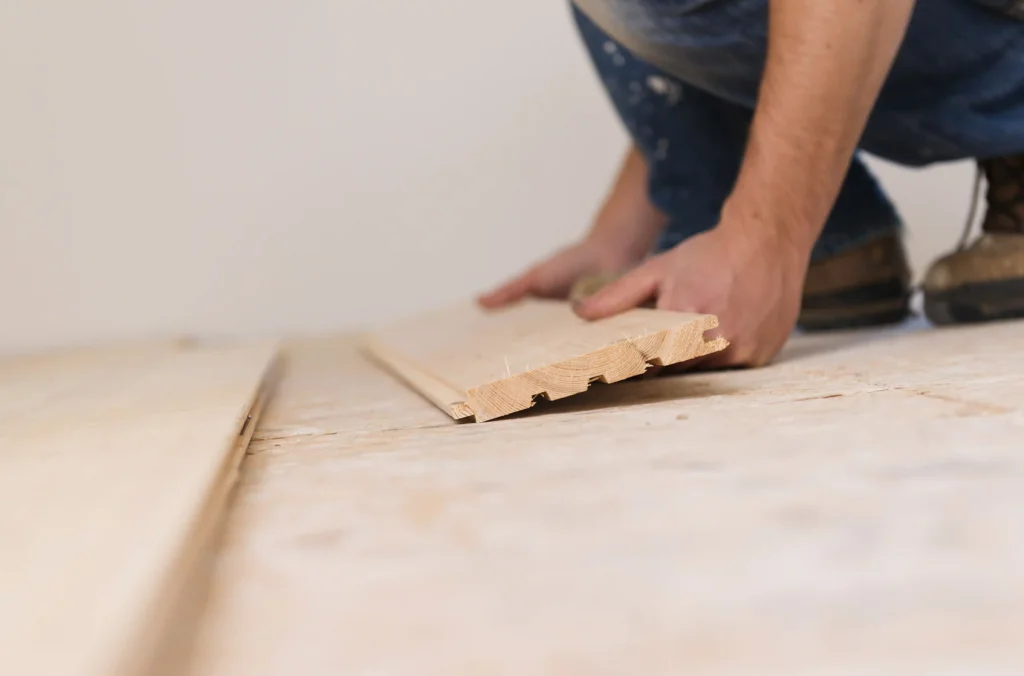
Bamboo flooring requires 72 to 96 hours of acclimation in the installation environment before laying, during which the planks adjust to the ambient temperature and humidity of the room. Skipping or shortening this period causes post-installation movement — gaps in dry conditions or buckling in humid ones — because the planks were not at equilibrium moisture content when fastened. The correct acclimation process for bamboo includes stacking planks with spacers, maintaining the room at installation humidity levels, and testing subfloor moisture before proceeding.
Susceptibility to Sunlight Fading and UV Discoloration
Bamboo changes color under prolonged UV exposure. Natural bamboo yellows and darkens toward an amber tone over 3 to 5 years in sun-exposed rooms. Carbonized bamboo lightens unevenly under UV, because the caramelized surface compounds break down at different rates. Areas protected by rugs or furniture develop visible color contrast against exposed sections within 12 to 24 months in south-facing rooms. UV-blocking window film reduces fading rate by approximately 50 percent.
How the Pros and Cons Stack Up by Bamboo Type
Strand-woven bamboo carries the strongest performance profile of the three main types. Its 3,000 to 5,000 lbf hardness, compressed-fiber density, and lower moisture expansion rate make it the most suitable choice for high-traffic residential spaces and light commercial use. How strand-woven bamboo differs from conventional solid bamboo extends beyond hardness — its entire construction method produces a more dimensionally stable, dent-resistant, and wear-resistant product.
Horizontal and vertical solid bamboo offer a natural aesthetic with genuine grain character but require more careful humidity management, more conservative installation locations, and more realistic expectations about dent resistance. They suit low-to-moderate traffic rooms in climate-controlled homes where humidity stays between 40 and 60 percent year-round.
Engineered bamboo provides the broadest installation compatibility — including glue-down over concrete and use with radiant heat — but its thin veneer limits refinishing and shortens the overall service life compared to solid variants. The structural and performance differences between solid and engineered bamboo determine which product fits a specific subfloor type, climate, and maintenance tolerance.
Where Bamboo Flooring Performs Well and Where It Fails
Bamboo performs reliably in living rooms, bedrooms, dining rooms, home offices, and low-humidity hallways where foot traffic is consistent and spill exposure is limited. Strand-woven products extend viable use to kitchens when spills are cleaned within minutes, provided the subfloor is level and dry. Which rooms suit bamboo flooring depends on both the bamboo type and the specific environmental conditions of the space, not a blanket suitability rule.
Bamboo fails in full bathrooms, laundry rooms, unfinished basements, and spaces adjacent to exterior doors without adequate transition protection. It also underperforms in homes without climate control where seasonal humidity swings exceed a 30 percent range. The conditions that make bamboo a poor choice include chronic dampness, high-volume pet households without nail management, and situations where refinishing access is limited.
The Quality Variable That Changes Everything
The pros and cons of bamboo flooring are not fixed — they shift dramatically based on manufacturing quality. A CARB Phase 2-certified, strand-woven bamboo plank from a manufacturer who publishes third-party test results is a fundamentally different product from an uncertified horizontal bamboo floor sourced from a factory with no published quality documentation. The performance ceiling of the best bamboo products reaches or exceeds premium domestic hardwood. The performance floor of the worst bamboo products fails faster than budget laminate.
Buyers who focus only on price-per-square-foot comparisons and ignore certification status, plank thickness, bamboo harvest age, and manufacturer transparency make the mistakes that generate negative reviews about bamboo flooring. The material’s reputation suffers from low-grade products that share the name with genuinely high-performance flooring. What separates cheap from premium bamboo flooring provides the specification checklist needed to avoid purchasing the category’s worst performers.
Is Bamboo Flooring Worth Installing?
Bamboo flooring delivers measurable value for buyers who select the correct type for their specific room conditions, verify certifications before purchasing, and maintain humidity between 40 and 60 percent year-round. Strand-woven bamboo in particular offers a hardness-to-cost ratio that no domestic hardwood can match, with a material price 30 to 50 percent below equivalent-hardness exotics like Brazilian cherry or Santos mahogany.
The decision ultimately comes down to two variables: environmental control and product selection. Homes with stable HVAC, controlled humidity, and buyers willing to verify manufacturer documentation will find bamboo a durable, sustainable, and cost-effective floor. Homes with chronic moisture issues, no climate control, or buyers purchasing based on price alone will encounter the failures bamboo is most criticized for. The floor is not the problem — the mismatch between product choice and installation environment is.
For buyers weighing bamboo against the alternatives, how bamboo compares directly to hardwood flooring across hardness, cost, moisture tolerance, and refinishing potential provides the side-by-side data needed to make a final decision.