Construction methods
Solid bamboo. A plank milled from a single continuous piece of processed bamboo rather than a veneer bonded to a core. Solid bamboo can be sanded and refinished multiple times over its service life because there’s no thin wear layer to sand through — the plank is the same material top to bottom. Full comparison on solid vs. engineered bamboo flooring.
Engineered bamboo. A plank built as a cross-ply layered structure: a real bamboo top layer (the wear layer) bonded to a stable core, typically plywood or high-density fiberboard, running in a cross-grain pattern beneath it. The cross-ply core is what gives engineered bamboo better dimensional stability against humidity swings than solid bamboo, which is why it’s the more common construction for basements, over-concrete installs, and radiant heat. Full comparison on solid vs. engineered bamboo flooring.
Horizontal bamboo. A construction method where bamboo strips are laid flat, wide-side up, and glued in stacked layers — the construction that produces bamboo’s characteristic visible node pattern (the small horizontal lines from the bamboo stalk’s growth segments) most prominently, since the flat face of each strip is what shows on the plank surface.
Vertical bamboo. A construction method where bamboo strips are turned on edge and glued side by side before milling into planks. This produces a tighter, more linear grain appearance with less visible node pattern than horizontal construction, and it’s typically slightly harder than horizontal bamboo of the same species and age, because more fiber cross-sections are packed into the same wear-surface area.
Strand-woven bamboo. A construction method distinct from both horizontal and vertical bamboo, built by shredding bamboo into fibers, compressing them under extreme heat and pressure into a bonded block, and milling planks from that block. There are no visible layers in strand-woven bamboo the way there are in engineered construction — it’s a single dense material throughout — and the process is what produces the high Janka hardness figures documented on bamboo flooring hardness explained and detailed further on what is strand-woven bamboo flooring.
Rigid core (HDPC/SPC). A construction category distinct from all four bamboo constructions above, where a strand bamboo wear layer is bonded to a waterproof composite core — high-density polymer composite (HDPC) or stone-plastic composite (SPC) — rather than a wood or bamboo substrate. This is the construction behind the waterproof claims on hybrid bamboo products like Ambient’s rigid-core line and Costco Next’s Golden Arowana HDPC line, both covered on best bamboo flooring brands and bamboo flooring at Costco / big-box retailers. It’s the reason “is bamboo flooring waterproof” doesn’t have a single yes/no answer — see is bamboo flooring waterproof for the construction-by-construction breakdown.
Processing methods
Carbonized. A heat-treatment process applied to bamboo strips before construction, darkening the natural blonde color to an amber or brown tone through controlled heating rather than surface staining — meaning the color runs through the strip rather than sitting on top of it. Carbonization also softens the bamboo somewhat compared to its natural (uncarbonized) state, which is why carbonized solid bamboo tends to test lower on the Janka scale than natural solid bamboo of the same species, a distinction that matters when comparing hardness figures across product lines, as flagged on best bamboo flooring brands for EcoForest’s carbonized vs. stranded lines specifically.
Natural (uncarbonized). Bamboo processed without the carbonization heat treatment, retaining its original lighter, blonde-to-gold color and slightly higher hardness than the same species carbonized.
Wear layer. The top surface layer of an engineered plank — the part that shows once the floor is installed and the part that takes foot traffic, scratches, and refinishing sanding. Wear layer thickness is the single number that determines how many times an engineered floor can be refinished before sanding cuts through into the core material below; typical engineered bamboo wear layers run from roughly 1.5mm to 6mm, and thicker wear layers support more refinishing cycles. This term doesn’t apply to solid bamboo, since a solid plank has no separate wear layer — the whole plank is refinishable material. See bamboo flooring thickness for how wear layer thickness factors into overall plank thickness specs, and can bamboo flooring be refinished for the refinishing-cycle implications directly.
Aluminum oxide finish. A hard, scratch-resistant topcoat finish applied in multiple coats over the wear layer (or over solid bamboo’s top surface) — the finish layer itself, not the bamboo underneath it. This is the layer a surface-level scratch damages without reaching the bamboo fiber, the distinction covered in depth on bamboo flooring scratch repair. More coats generally mean more scratch resistance and a longer interval before the finish itself needs attention, independent of the hardness of the bamboo underneath. Full breakdown of finish categories on bamboo flooring finish types.
Hardness and material terms
Moso bamboo. The bamboo species (Phyllostachys pubescens) used in the overwhelming majority of flooring-grade bamboo products, prized over other bamboo species for its density and fiber consistency. Manufacturer spec sheets that name a specific species at all — Teragren’s “Optimum 5.5” naming is the most explicit example on best bamboo flooring brands — are almost always describing a harvest-age or processing variant of Moso rather than a different species entirely.
Janka hardness / Janka scale. A standardized test (ASTM D1037 for engineered wood products, ASTM D143 for solid lumber) that measures the force, in pounds-force (lbf), required to embed an 11.28mm steel ball halfway into a material’s surface. Higher numbers mean a harder, more dent-resistant surface. The scale is the common reference point for comparing bamboo against traditional hardwoods — red oak sits around 1,290, while strand-woven bamboo commonly tests above 3,000 and sometimes above 5,000 depending on the manufacturer and construction. Full explanation on bamboo flooring hardness explained. Janka results vary lot to lot even from the same manufacturer, which is why this page and the brand comparison page both treat a published Janka figure as a manufacturer claim to be checked against the specific product line rather than a fixed brand-wide constant.
Certifications and air-quality terms
VOC (volatile organic compounds). Chemical compounds released into the air as a flooring product’s adhesives and finishes off-gas, most heavily during and shortly after installation. Lower-VOC products are marketed as better for indoor air quality, and VOC emissions are the metric most of the certifications below are actually testing. Covered in depth on bamboo flooring safety and VOCs.
FloorScore certification. A third-party indoor air quality certification specific to hard-surface flooring, testing for compliance with VOC emission limits. Referenced as a spec-sheet claim on nearly every premium bamboo brand’s marketing, including Cali, Teragren, and Ambient as documented on best bamboo flooring brands.
CARB Phase 2 compliance. Compliance with the California Air Resources Board’s Phase 2 formaldehyde emission limits for composite wood products — relevant specifically to engineered bamboo’s plywood or fiberboard core, since that’s the component most likely to use formaldehyde-based adhesives. A CARB Phase 2 claim is a core-material claim, not a claim about the bamboo wear layer itself.
E0 / E1 emission standards. European formaldehyde emission classifications for composite wood products, with E0 representing the stricter (lower-emission) standard and E1 the more common baseline compliance level. Manufacturer spec sheets that cite “below E0” or “E1 compliant” are making the same kind of core-material claim as a CARB Phase 2 citation, just under a different regulatory framework — the two aren’t equivalent tests and a product can cite one without the other.
FSC (Forest Stewardship Council) certification. A third-party certification verifying that the bamboo (or the wood components in an engineered core) was sourced under sustainable forestry/harvesting standards. Offered as an option on some but not all product lines within a brand’s catalog, meaning “FSC certified” describes a specific SKU rather than a blanket brand-wide claim. Related sustainability claims covered on is bamboo flooring eco-friendly and bamboo flooring sustainability myths.
Grading terms
Grade. In bamboo flooring, as in hardwood flooring generally, “grade” describes appearance — color consistency, visible node markings, natural variation between planks — not durability or hardness. There is no single governing body setting bamboo grading standards the way there is for some hardwood species; each manufacturer sets its own grade names and criteria, which is why a “Select” or “Grade A” label from one brand isn’t directly comparable to the same label from another without checking what that specific manufacturer’s grade actually excludes. Full breakdown on bamboo flooring grades explained.
Select / Premium grade. The most visually uniform grade tier a manufacturer offers — minimal color variation plank to plank, few or no visible natural markings. Typically the most expensive grade tier within a given product line, since more raw material gets rejected to fill it.
Character / Rustic grade. A grade tier that permits more natural variation — color shifts, visible node markings, more pronounced grain differences between planks — marketed as a more organic or natural look rather than a defect. Character grade is generally less expensive than Select grade within the same product line, not because it’s less durable, but because more of the raw material qualifies for it.
Surface texture and edge profile terms
Smooth / traditional finish. A flat, uniform surface texture with no applied texturing beyond the finish coat itself — the baseline surface texture most bamboo product photography defaults to.
Hand-scraped finish. A surface texture manufactured to resemble the look of hand-tooled, individually scraped planks, adding visible texture and depth rather than a flat uniform surface. A hand-scraped texture also does double duty as light scratch camouflage in high-traffic rooms, since existing surface texture makes new surface scratches less visually distinct than they’d be against a smooth finish.
Wire-brushed finish. A surface texture created by mechanically brushing the plank surface to raise and emphasize the natural grain pattern, producing a texture between smooth and hand-scraped.
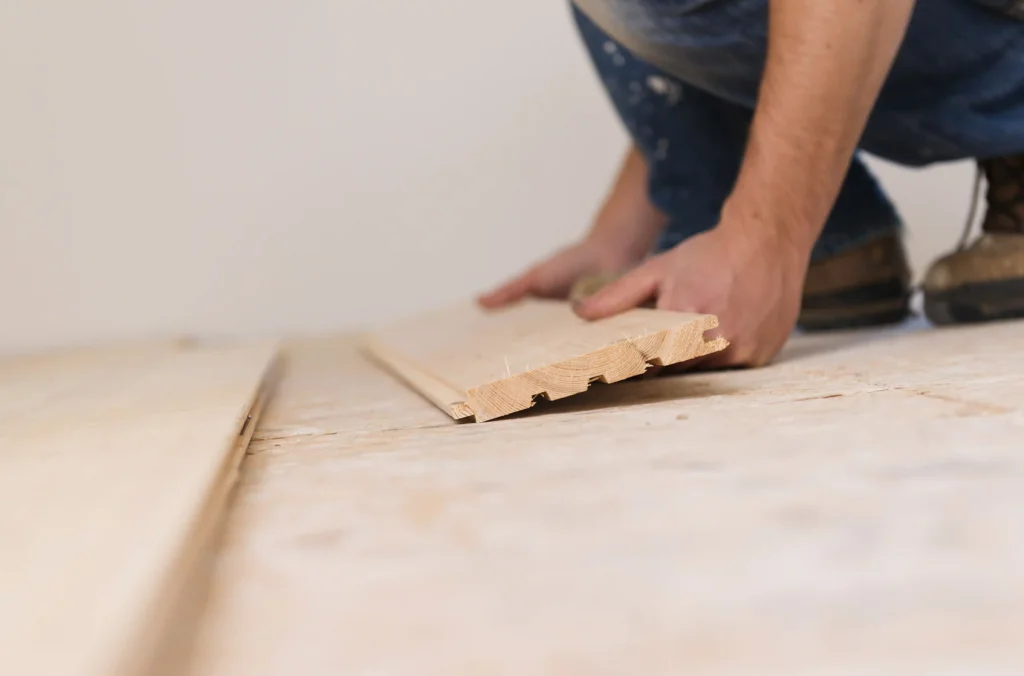
Tongue and groove (T&G). An edge-milling profile where one edge of each plank has a protruding tongue and the opposite edge has a matching groove, allowing adjacent planks to interlock. T&G is the traditional profile for nail-down and glue-down solid bamboo installation, distinct from click-lock, which is a different edge profile built specifically for floating installation.
Micro-bevel. A small, often barely visible angled edge milled along the top edge of each plank, creating a slight V-groove where two planks meet once installed. Micro-bevels help disguise minor unevenness in the subfloor and make individual plank lines more visually distinct; a fully flush (non-beveled) edge gives a more seamless, single-surface look but shows subfloor irregularities more readily.
Installation terms
Floating installation. An installation method where planks click-lock together into a continuous floor that is not fastened to the subfloor beneath it — the floor “floats” as a single connected unit that can expand and contract slightly with humidity changes without being pinned in place. Common with engineered bamboo’s click-lock systems. Full comparison on floating vs. glue-down bamboo flooring.
Glue-down installation. An installation method where planks are adhered directly to the subfloor with flooring adhesive, more common with solid bamboo and installations over concrete where a floating floor’s slight movement isn’t desired. Also covered on floating vs. glue-down bamboo flooring.
Nail-down installation. An installation method, mostly limited to solid bamboo over a wood subfloor, where planks are fastened directly through the tongue with flooring nails or staples — the traditional hardwood installation method, requiring a nailer rated for the plank’s thickness.
Click-lock (Uniclic). A specific mechanical locking-edge profile that lets planks snap together without glue or nails, enabling floating installation. Uniclic is a specific branded version of this locking system referenced by name in several manufacturer spec sheets, including Mohawk’s Hilea and Kahala lines documented on best bamboo flooring brands.
Acclimation. The period during which bamboo flooring boxes sit unopened (or opened but stacked, per manufacturer instructions) in the room where they’ll be installed, allowing the material to adjust to that room’s humidity and temperature before installation locks the planks in place. Skipping or shortening this period is a documented cause of post-installation gapping and cupping, covered on bamboo flooring acclimation process and bamboo flooring acclimation mistakes.
Expansion gap. A deliberate small gap left between the flooring and the wall (later covered by baseboard or trim) to allow the floating or glued floor room to expand slightly with humidity changes without buckling against a fixed wall. Covered in depth on bamboo flooring expansion gap mistakes.
Common failure-mode terms
These five terms already have dedicated deep-dive pages on this site; the entries below are intentionally short; the point of including them here at all is so a page discussing an unrelated attribute (cost, installation, a specific brand) can link a term back to its canonical definition without re-explaining the failure mechanism inline.
Cupping. The edges of a plank rise higher than its center, usually from moisture imbalance between the top and bottom of the plank. Full mechanism on bamboo flooring cupping explained.
Buckling. Planks lift away from the subfloor entirely, often in a visible ridge — a more severe and less common failure than cupping, usually tied to sustained moisture exposure or missing expansion gaps. Full mechanism on bamboo flooring buckling causes, mechanisms, and prevention.
Warping. A broader term for a plank losing its flat shape — twisting, bowing, or crowning — distinct from cupping’s specific edge-vs-center pattern. Full mechanism on why bamboo flooring warps.
Delamination. The bonded layers of an engineered plank (wear layer and core) separating from each other, distinct from surface-level finish problems since it’s a bond failure between structural layers rather than a cosmetic issue. Full mechanism on bamboo flooring delamination.
Gapping. Visible gaps opening between planks, most commonly a dry-season/low-humidity issue as planks contract — the seasonal opposite of the swelling that causes buckling. Full mechanism on bamboo flooring gaps between planks.